Slurry testing as silage season ready to kick off

With a high pressure forecast to roll in over the weekend, bringing with it spells of warm dry weather, there is bound to be a bit of grass knocked.
A fair shot of silage has already been cut this month, with plenty more paddocks ready now and just as many still a few weeks away.
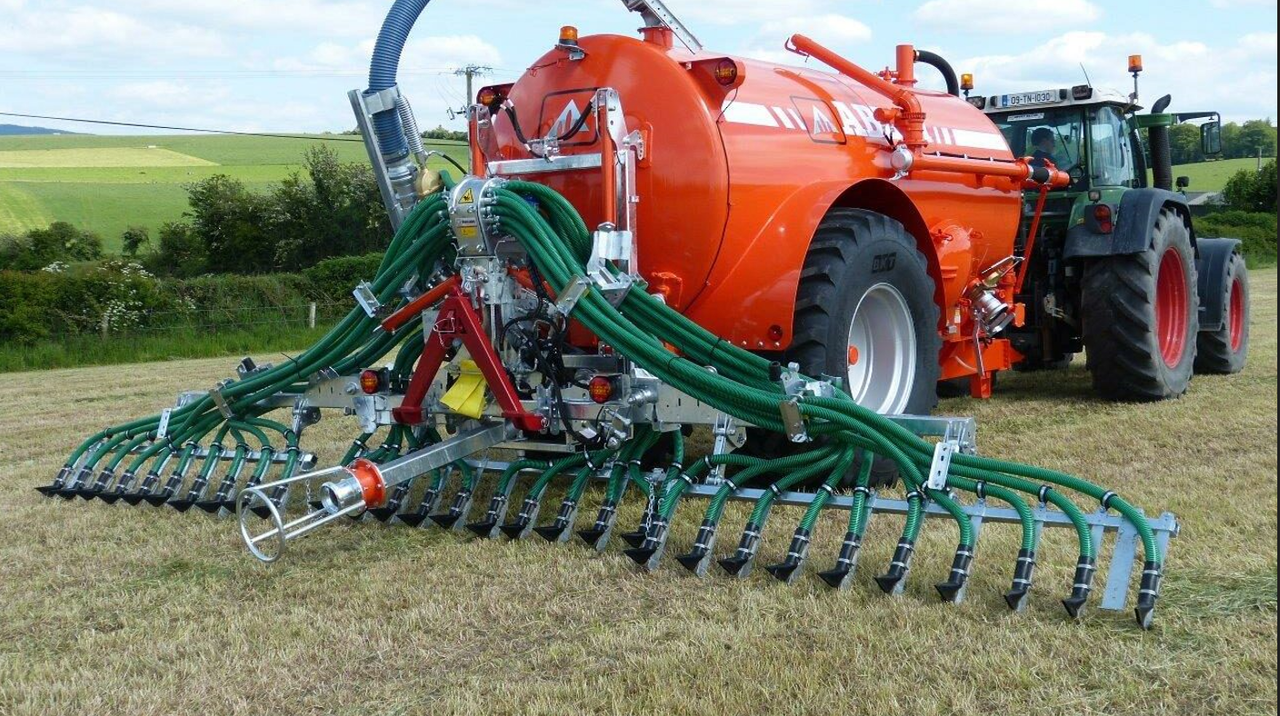
Either way, over the next few weeks there will be plenty of mowers on the go, with slurry tankers not far behind them.
There will be a real focus on slurry applications this year and getting the ground fertilised to boost grass growth, as silage reserves are low and cutting dates have already being delayed.
Slurry has a big part to play in second-cut silage and getting phosphorus (P) and potassium (K) into the ground.
Slurry application
A typical bale of silage with about 200kg of dry matter (DM) contains 10 units of nitrogen (N), 1.6 units of P, and 10 units of K.
That means quality first cuts of 3,000kg/DM/ha will be yielding roughly 6 bales/ac, but depleting the soil of approximately 60 units of N/ac, 9.6 units of P, and 60 units of K, which will all need to be replaced.
From thick cattle slurry with a DM of about 6%, about 2,000gal/ac is needed to replace the P and K that has been removed.
This should be followed with an application of 1.2 bags/acre of protected urea + sulphur (S) product to make up the N offtakes.
Lighter slurry may need to be spread at a rate of 3,000-3,500gal/ac to replace the offtakes.
This discrepancy highlights the importance of getting your slurry tested to know what nutrients are actually going out, ensuring you are not wasting valuable fertiliser on paddocks with sufficient nutrients, or going to light and limiting growth and yields.
Cattle slurry with a 6% DM, when using low emission slurry spreading (LESS), is approximately six units of N, five units of P, and 32 units of K for every 1,000gal.
However, this can differ substantially from farm to farm.
In order to grow 4t of grass DM/ha (8t/ac fresh weight), you will need to apply 80 units of N/ac, 13 units of P/ac, and 80 units of K, and this can be done through 2,500gals/ac of 6% DM slurry followed by 1.6 bags/ac of protected urea + S.
Slurry testing
The way to get the most out of your organic fertiliser is to get it tested to determine its nutrient value.
Currently, slurry is estimated to be worth up to and over €30 per 1,000/gal, if you take into account the nitrogen, potassium, and phosphorus in it.
Considering its worth - especially compared to inflated chemical fertilisers - it is vital to get it tested and know its value so it can be used efficiently.
Once testing has been done, you can then alter your nutrient management plan and fertiliser application based on what is contained within your slurry.
Slurry testing can also allow farmers to target slurry with higher P and K levels to silage ground, whereas slurry with a lower nutritive value can be applied to grazing swards, for which the requirement for P and K is typically lower.