Ireland's dearest farmlands revealed in new survey

Farmland prices across Ireland show a widening regional divide, with new figures placing Wexford at the top of the market in several categories.
The findings for 2025 point to a land market that "remained very active and competitive", underpinned by strong demand and the continued scarcity of land coming to market.
This is according to the Annual Agricultural Land Market Review Outlook 2026 report produced by Teagasc and the Society of Chartered Surveyors Ireland (SCSI).
The latest annual survey found that an acre of good-quality land in Wexford now averages €19,226, among the highest in the country, while poor-quality land in Leitrim is valued at just €3,772 per acre.
The report also points to rising demand in the rental sector, with prices increasing across all regions—most sharply in Munster and Connacht/Ulster—highlighting continued pressure on land supply and strong competition among farmers.
Sales
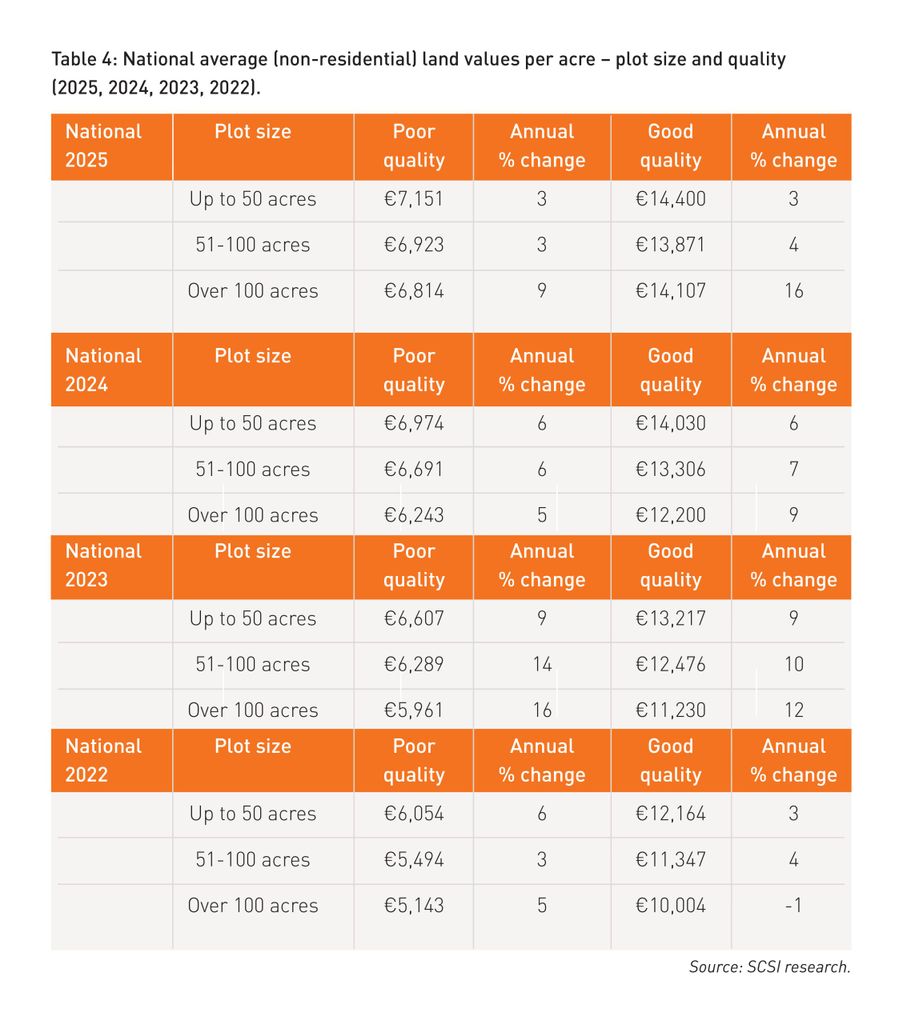
This year’s annual survey, the 13th in the series, provides a county-by-county breakdown of the prices of good and poor-quality land, in three categories: under 50ac; between 51-100ac; and over 100ac.
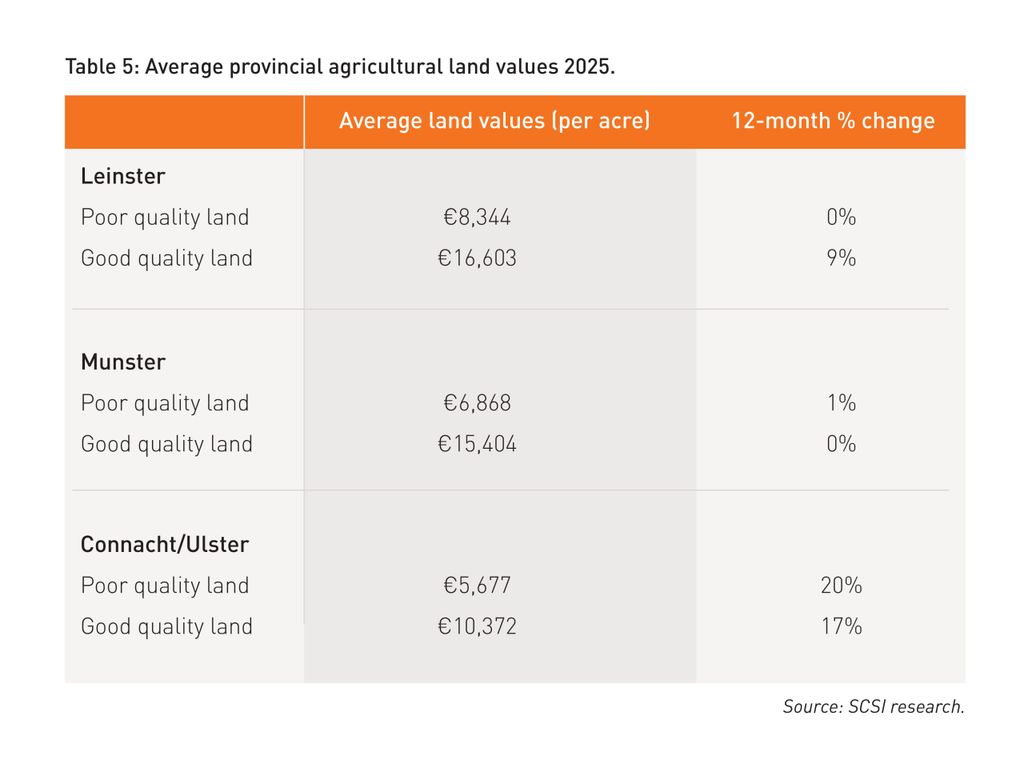
Looking at sales, farmland values for poor quality and good quality land are (per acre) were €6,963 and €14,126 on average across the three categories, respectively.
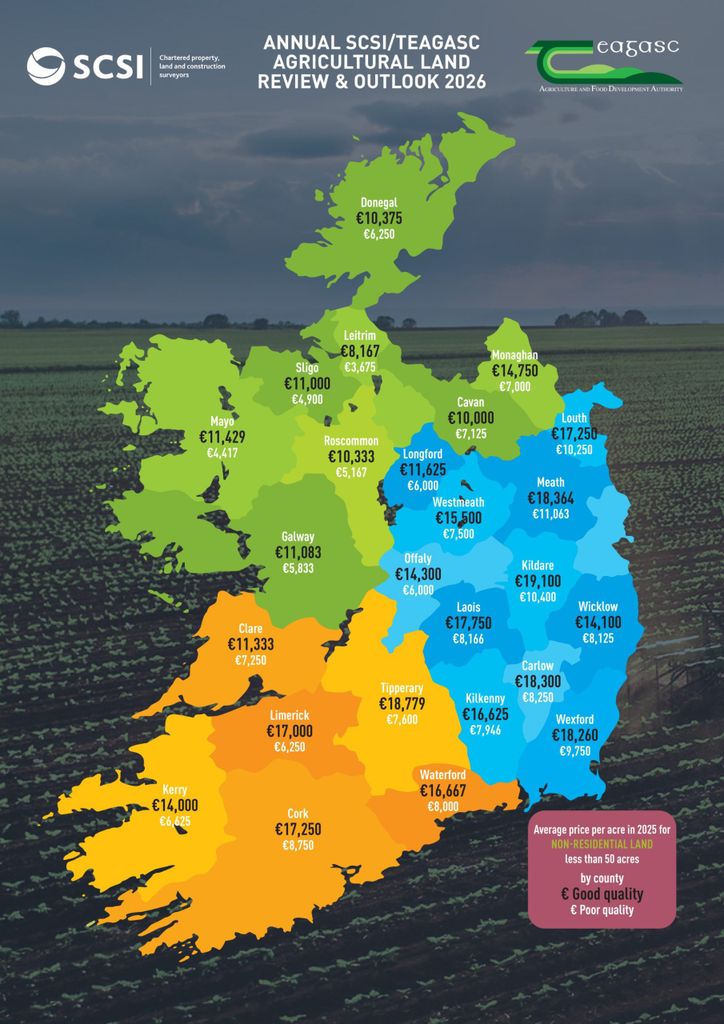
For the period surveyed, across all categories of land parcels, Wexford has the highest average good quality land value at €19,226/ac (closely followed by Kildare at €19,200), while Leitrim has the lowest average poor quality land value at €3,772.
Intergenerational transfer of farmland valuations, now up 36% (net balance), have remained at high levels since 2020.
Probate sales continue to be the most active seller type, according to 96% of agents, which has been the dominant trend since 2015.
The survey responses suggest that farmland sales activity "strengthened during 2025", pointing to a more active market compared with the previous year.
This shift indicates a "renewed level of engagement among buyers and sellers, following a period where activity had been relatively stable".
The survey found that even modest changes in the number of land transactions "can be keenly felt in the Irish context, given the very limited proportion of farmland that typically comes to the market in any given year".
Broader market conditions may have supported this increase in activity, the report said.
Greater certainty around financing conditions "appears to have improved confidence among prospective purchasers".
"Agents also report that non-market factors, such as changes in family circumstances and farm restructuring, continue to play an important role in bringing land to the market".
These factors highlight that farmland sales "are often driven by structural and personal considerations, as much as by short-term market dynamics".
Leasing and rentals
The survey found “continued landowner shift towards long-term leasing over short-term rentals”.
The 2024 SCSI Long-Term Lease Index was at 74%. It is up 67% net balance in 2025, indicating a continued increase in this activity.
The net balance for short-term rental volume is down 20% (which was down 22% in 2024), indicating a sustained decline.
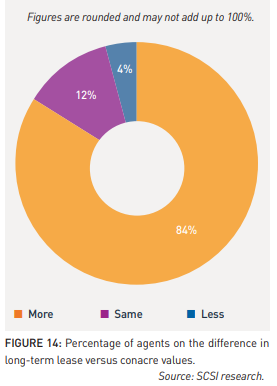
The survey also found that 84% of agents noted that farmers "typically pay more per acre for similar quality land on a long-term basis compared to short-term lets".
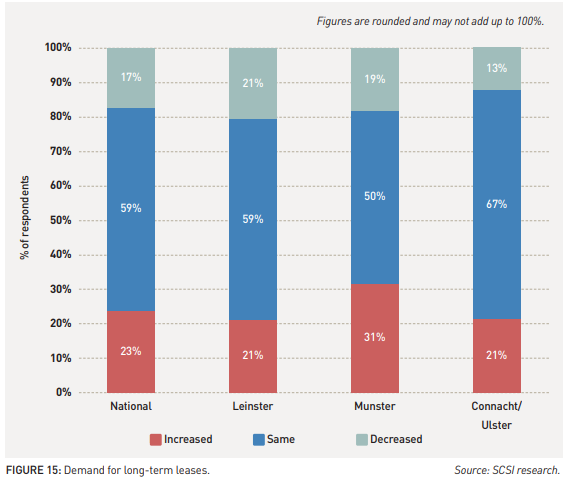
Demand for long-term leasing remained strong in 2025. Nationally, 23% of agents reported an increase in demand, while 59% indicated that demand remained stable.
At a regional level, the strongest increase was reported in Munster, where 31% of agents indicated rising demand, reflecting strong competition for land in the region.
In Leinster and Connacht/Ulster, most agents reported that "demand remained broadly unchanged, although the overall level of demand remains high".
Longer-term survey trends also highlight the sustained importance of this segment in the rental market.
The net balance index of demand for long-term leasing remained "strongly positive" at 67% in 2025, continuing a trend of high demand recorded since 2017.
Additionally, members have noted that the "recent changes to rules on taxation of income from long-term leasing, including the seven-year holding requirement since January 2024, have helped to tackle the issue of use of agricultural relief as part of inheritance tax planning strategies by wealthy non-farmers".
At the same time, the index for conacre transactions remained negative, down 20% in 2025.
The survey found the "relative shift towards long-term leasing reflects broader structural trends within Irish agriculture".
It said: "Since long-term leasing can better facilitate farm expansion, generational renewal and improved land management, it has become an increasingly important mechanism land mobility within the sector."
SCSI agents further reported that the average duration of lease agreements remained broadly stable in 2025, with 61% indicating no change compared with 2024.
Rental values rose by 10% on average across all farming uses.