Only 5 out of 84 board members of major Irish dairy co-ops are women
Despite mandatory gender pay gap reporting, Ireland's biggest dairy cooperatives remain male-dominated at board level.
With this year being the 'International Year of the Woman Farmer', the co-ops' 2025 gender pay gap reports add new layers to the discussion.
Ireland's major dairy co-ops processed over 8.7 billion litres of milk last year, while according to Bord Bia's Export Performance and Prospects Report 2025-2026, Irish dairy exports topped €7.3 billion in 2025.
Yet when it comes to who is sitting around the board table making decisions that affect thousands of farming families, it is primarily men.
The figures
Based on the latest information currently available from the co-ops' official websites:
- Aurivo's board of directors has 14 members; none of whom are women;
- Tirlán's board of directors has 16 members; two of whom are women;
- ArraTipp's board of directors has 20 members; none of whom are women;
- Dairygold's board of directors has 12 members; with only one woman;
- Carbery Group's board of directors has 9 members; with only one woman;
- Lakeland Dairies' board of directors has 13 members; with only one woman.
Across the six co-ops, the total number of members on the board of directors was 84, of which only five were women.
That is a female representation rate of just 6%.
Gender pay gap reports
Under the Gender Pay Gap Information Act 2021, Irish companies with more than 50 employees are required to publish annual pay disparities between men and women.
It is important to note what the term 'gender pay gap' actually means.
According to the Department of Children, Disability and Equality, "the gender pay gap is not only about equal pay for equal work or work of equal value, which is required under the Employment Equality Acts, but about gender representation".
"Even if an employer has an effective equal pay policy, it could still have a gender pay gap if, for example, the majority of women are employed in lower-paid jobs."
In gender pay gap reports:
- The term 'mean pay gap' refers to the difference between the average hourly pay of men and women. This is expressed as a percentage of the mean hourly pay of male employees, so will be a minus percentage if women have a higher mean pay rate;
- The term 'median pay gap' refers to the difference between the midpoints in the ranges of men and women's pay, expressed as a percentage of the median hourly pay of male employees, so will be a minus percentage if women have a higher average median pay rate.
The various co-op's 2025 gender pay gap reports reveal what gender imbalance looks like not just at board level, but throughout its workforce.
Aurivo
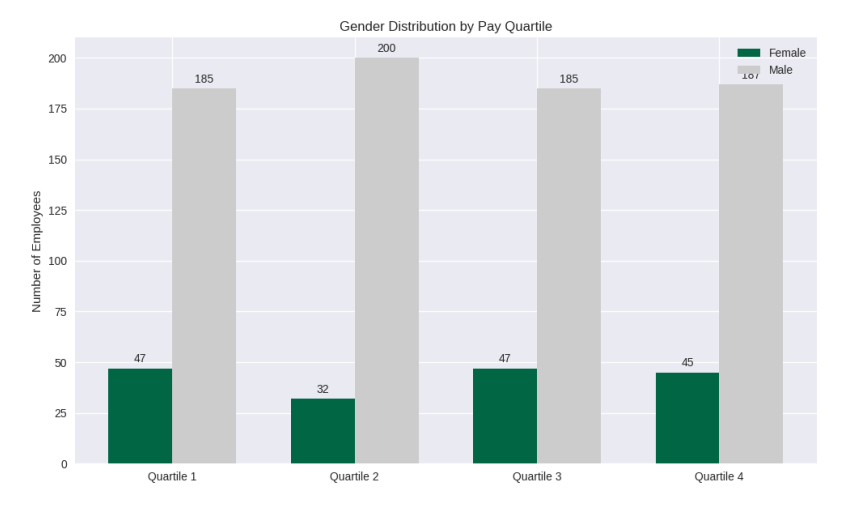
The co-op reported 18% of its workforce was made up of women, the lowest figure out of any of the co-ops included in this article.
It reported a mean pay gap of -0.9% and a median pay gap of -3.1%, meaning women earned slightly more than men on average.
The co-op's mean bonus gap stood at -3.1% and had a median bonus gap of -11.1%, both in favour of women.
However these figures could reflect a common theme.
In a business, if a higher proportion of women work in higher-paid or specialist roles, this can create favourable pay gap results even if a company's overall female representation remains low.
Aurivo highlighted this factor in its report, as it stated that the figures reflect "the strong representation of women in senior and specialist roles, despite their smaller overall share of the workforce (18%)”.
Tirlán
Tirlán's data from over 2,000 employees - taken in June 2025 - reported a mean pay gap of 4.5%, a four percentage point improvement on 2024 results.
Last year also saw the median gap decrease to -0.4%, down 6.7 percentage points on 2024 levels.
The co-op's Gender Pay Gap Report 2025 stated that "in respect of the bonus, there is a 15.2% gap in favour of men", explaining that this mean bonus figure was 27.4% in 2024.
Meanwhile, its median bonus gap was -38% in favour of women, which reflects “the higher proportion of women in roles which attract a higher bonus range”.
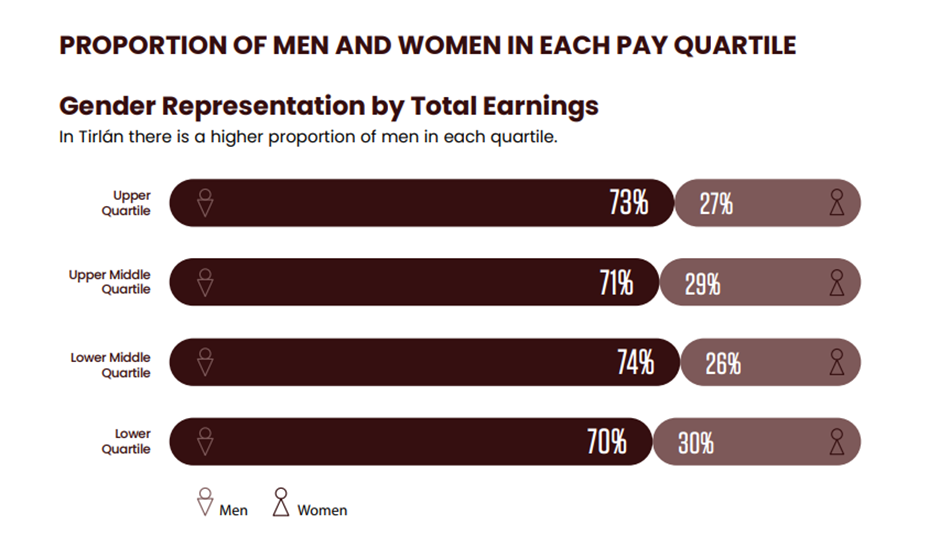
Tirlán's workforce was comprised of 72% males and 28% females, with more men than women at every pay level.
The co-op reported that its production environments have a large number of male employees, enabling "greater access for production employees to additional pay elements such as overtime and allowances".
ArraTipp
According to ArraTipp's 2025 report, the newly merged co-op employs 463 people, 105 of whom are women (23%).
The co-op had a mean pay gap of 19.9% and a median pay gap of 25%, the highest of the six co-ops mentioned in this article.
“Despite an increase in our pay gap post merger, our results sit in the middle of the range of other dairy producers and provide a good base to make further progress in coming years," the report said.
ArraTipp’s report acknowledges that the gap reflects "the merger of two existing dairy business with different reward and development models.
"There are more males than females who have received a bonus payment," it added.
The report noted that the mean bonus gap of 56.2% in favour of men “remains high”, which is "driven by higher salaries and bonuses on average being associated with seniority and role responsibilities", while its median bonus pay gap was -33.3%.
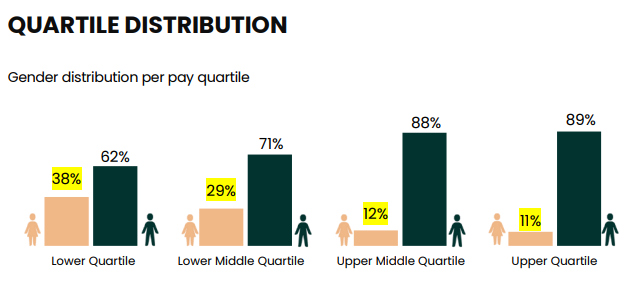
In the highest paid group, women made up 11% of employees, while men accounted for 89%.
ArraTipp stated: “Female colleagues are better represented in technical and support functions and remain underrepresented at senior managerial level.
“These factors are the key drivers for our mean Gender Pay Gap,” the co-op reported.
Dairygold
Dairygold reports its workforce of 1,130 was made up of 347 females (31%) and 783 males (69%) in 2025.
The mean pay gap was 9.4% and the median was 9.7%, with the report stating both are improvements on 2024 figures of 11.7% and 15.9% respectively.
The mean bonus gap was 37.6% and the median bonus gap was 30%, both in favour of men.
According to the report, "much of the gender pay gap arises because of the higher number of men occupying senior roles and in addition, the higher number of men working in shift-based roles".
“There is greater access within shift-based roles to additional pay elements such as overtime and shift allowances.
"Improving the gender pay gap from 11.7% in 2024 to 9.4% in 2025 marks positive progress but also highlights the need for further efforts to close the gender pay gap.”
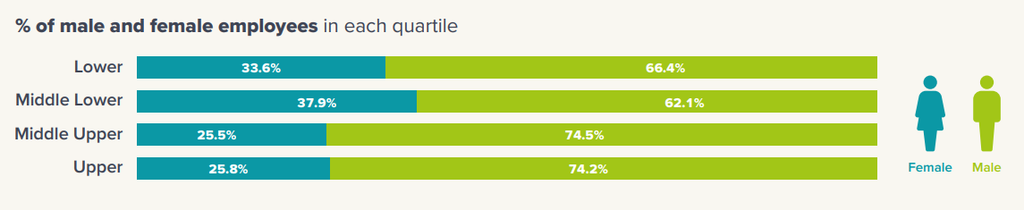
Women make up just 25.5% and 25.8% of the 'middle upper' and 'upper' pay groups respectively.
Dairygold chief executive, Michael Harte acknowledged in the report that “the higher number of men occupying senior roles” is a driver of the gap.
Carbery Group
Carbery Group’s report covers a workforce distribution of 70% male and 30% female, “reflecting the traditional demographics of the dairy sector”.
The mean pay gap in 2025 increased to 3% and the median pay gap to 6%, from 2024 figures of 2.7% and 3.5% respectively.
For 2025, Carbery reported a mean bonus gap of -18.3%.
However, a higher percentage of men (75%) actually receive a bonus in Carbery, compared to 65% of women.
The co-op's median bonus gap was -32%, "meaning the typical female employee earns a bonus approximately 32% higher than her male counterpart," the report stated.
“This difference in bonus outcome reflects the distribution of roles where discretionary bonuses apply", according to the report.
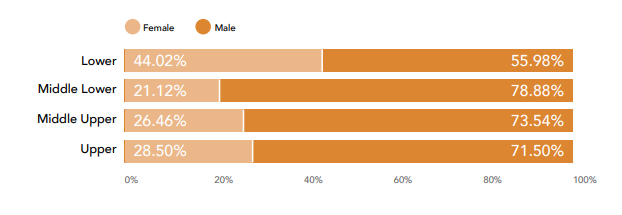
Among the highest-paid employees, 28.5% are women and 71.50% are men.
Lakeland Dairies
Lakeland Dairies' workforce was made up of 69% males and 31% females, “representing a shift from 74% male and 26% female in 2022”.
In 2025, the co-op reported a mean pay gap of 13.1% and a median pay gap of 11.2%.
The mean bonus gap was 18.9% in favour of men, with its median bonus gap of -6% in favour of women.
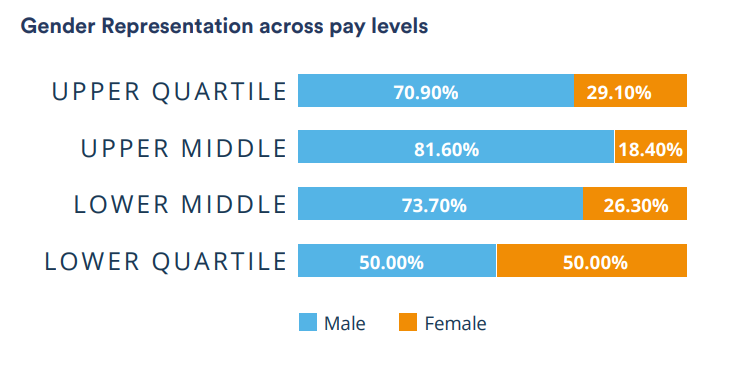
Women make up 18.4% of second highest-paid roles and 29.1% of the highest-paid roles.
Lakeland Dairies was the only co-op to report an equal number of men and women at any pay level, although this was in the lowest paid group.
Its report outlines that it "operates in a traditionally male dominated sector.
"These legacy dynamics contribute to the current gender distribution in senior roles and influence both our pay gap and bonus metrics," it added.
Words vs actions
What is most striking in all six of the co-ops’ gender pay gap reports is the contrast between the language of the industry's "future commitments" and the current boardroom reality.
Every one of these co-ops employs women at senior executive and professional levels.
Yet, across all six of the co-ops mentioned and 84 board seats, there are merely five female directors.
Co-op boards are elected from member shareholders, with these shareholders predominantly male farmers.
Until this diversifies, the pipeline into governance remains narrow.