New CAP must not discriminate against part-time farmers - INHFA

The Irish Natura and Hill Farmers Association (INHFA) has said the next Common Agricultural Policy (CAP) must support all farmers.
INHFA president Pheilim Molloy said the CAP programme, which currently supports over 118,000 farmers, "must not become the preserve of an elite".
The comments come as discussions around the CAP post-2027 intensify at a European and national level.
The Irish Creamery Milk Suppliers' Association (ICMSA) has proposed a definition of an active farmer which the farm organisation said "means a minimum 1 livestock unit (LU) per hectare stocking density".
INHFA
However, the INHFA president said the new CAP "must not discriminate against less intensive and part-time farmers".
He said any definition especially around stocking density should "recognise and accommodate the various land types and restrictions that farmers have to operate under".
"It has been suggested by some, that the new CAP programme should have a minimum stocking rate of 1LU/ha, which if applied could leave over 90,000 farmers or 80% without CAP support.
"While the remaining 20% may like this idea, the outcome would be devastating for rural communities and farming in general including for the 20% left as it would considerably weaken our lobbying ability while undermining critical services such as veterinary, contractors, our co-ops and other farm services," he added.
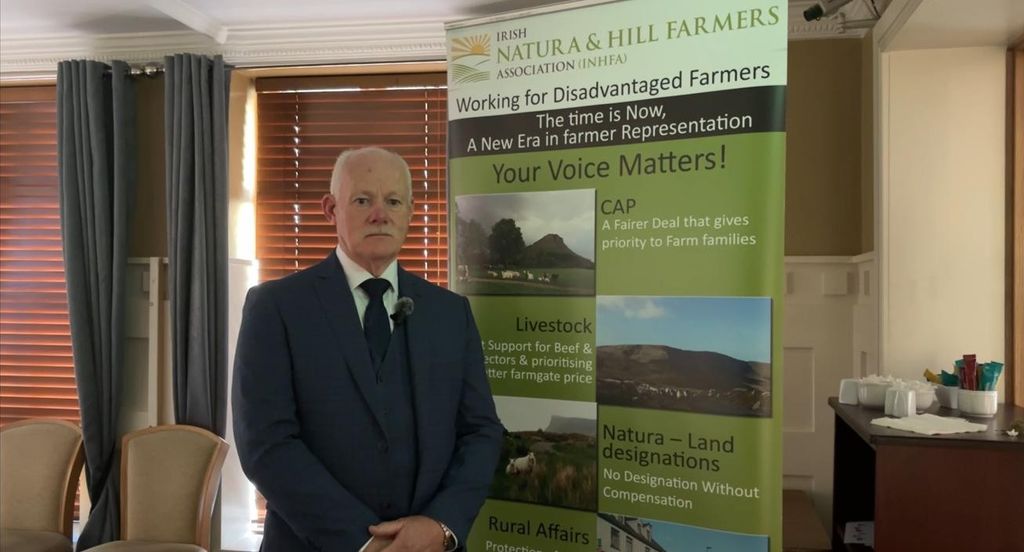
Molloy said the priority of everyone in the agri-food sector should be "to ensure as many farmers as possible remain actively involved in farming and CAP supports are a critical part of this".
"Farming practices are in most instances a reflection of the landscape, especially across our hills and on heavier peat soils, where farmers are limited in the type of stock and stocking rate they can carry.
"However, any such farmer is farming to the optimum while producing food sustainably in line with CAP requirements, so any attempt to penalise a farmer because of their land type isn’t just unfair, it undermines everything that CAP is about," he said.
CAP
The INHFA president also pointed to the "environmental restrictions" such as the Habitats Directive, which he said currently impacts "over 30,000 farmers".
"These restrictions which are covered under the Natura 2000 land designations have often restricted farming activity through specific actions such as the limiting of stocking density.
"Any attempt to restrict access to CAP funding through actions that doesn’t take into account the very limiting impact of these designations would definitely be challenged in the European Court of Justice, but we would hope it doesn’t ever come to that.
"Any attempt to divide farmers in order to support an elite will have devastating consequences for everyone," Molloy said.