Inside the '80%' food import figures 'sown' into debates this week

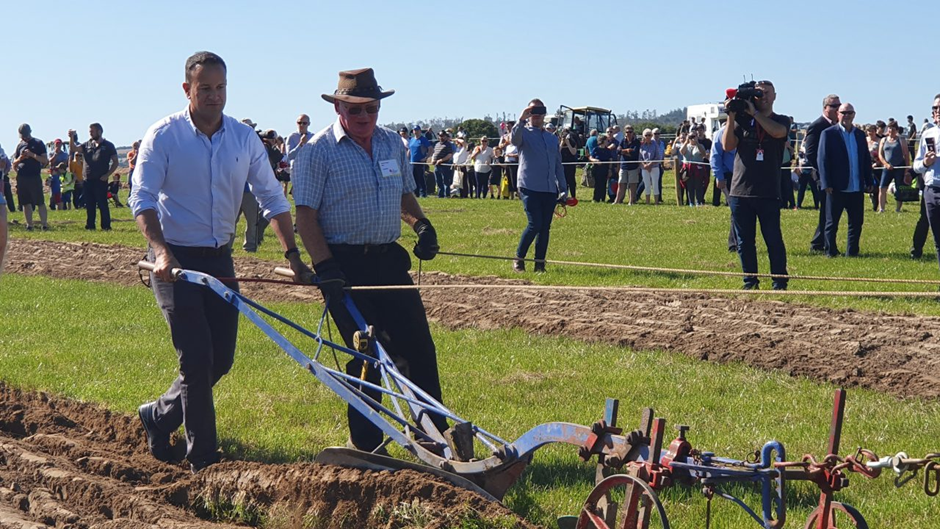
Former Taoiseach Leo Varadkar's comments that farmers “bring costs on Ireland” have sparked questions on Ireland’s reliance on imports and our food sovereignty.
Speaking on Matt Cooper's Path to Power podcast during the week, Varadkar claimed that farmers “still see themselves as the people who bring money and jobs into Ireland, where actually a lot of the time they bring costs on Ireland".
Matt Cooper then spoke about Ireland's level of imports, detailing that "around 80% of food consumed in Ireland is imported".
Ireland, as an island nation, must import a certain quantity of food to meet basic requirements.
These imports usually include foods that the Irish climate simply cannot produce, such as exotic fruits.
However as other imports, such as certain vegetables, can be produced here, many people may question the need for these foreign goods.
What are these imports?
According to the Central Statistics Office (CSO), Ireland imported 347,000t of fruit and nuts, valued at €563 million in 2024.
There were almost 96,000t of bananas, valued at €75 million and 56,000t of apples, worth €70 million imported in 2024.
Ireland also imported almost 12,000t of strawberries and other berries, valued at €86.8 million as well as 6,000t of nuts, valued at €30.4 million.
In 2024, Ireland imported fruit juice valued at €277 million, most of which was orange juice valued at €202 million.
Ireland also imported:
- 21,000t of coffee valued at €196 million;
- 15,000t of tea valued at €104.6 million;
- 82,700t of chocolate and cocoa products, valued at €578 million.
73% of the imports of chocolate and cocoa products came from the UK (47,600t), Germany (7,000t) and Belgium (5,800t).
Veg, meat and dairy
According to the CSO, Ireland imported 104,500t of potatoes in 2024, with a value of almost €67 million.
There were also 133,500t of prepared potatoes imported, valued at €245 million.
In addition, Ireland imported:
- 44,700t of onions (valued €40.5 million);
- 28,800t of carrots/turnips (valued €27 million);
- 28,000t of tomatoes (valued €60 million);
- 21,000t of cabbage (valued €30 million) in 2024.
Ireland's imports of bovine, sheep, pig meat and poultry were valued at €695 million in 2024.
Poultry imports valued at €286m accounted for almost 41% of meat imports.
There were 78,000t of poultry and 55,000t of pig meal and offal imported in 2024.
Ireland’s imports of milk amounted to €439 million in 2024, with €398 million (91%) imported from the UK.
Imports of cheese were valued at €290 million, with €110 million (38%) also coming from the UK.
Irish food exports
However, it is important to also highlight the strength of Irish food exports in this context.
According to Bord Bia’s most recent figures published in its Export Performance and Prospects 2025-2026 report, “the value of Irish food, drink and horticulture exports rose by 12% in 2025 to reach a record €19 billion”.
In the report, Bord Bia chief executive, Jim O'Toole said that the Irish agri-food sector performed well by "achieving record export values... reinforcing its reputation for quality, reliability and adaptability".
He commented that "food systems are, by nature, tight-margin operations, and the scale and pace of change in 2025 exposed vulnerabilities that leave little buffer for producers and businesses across the value chain".
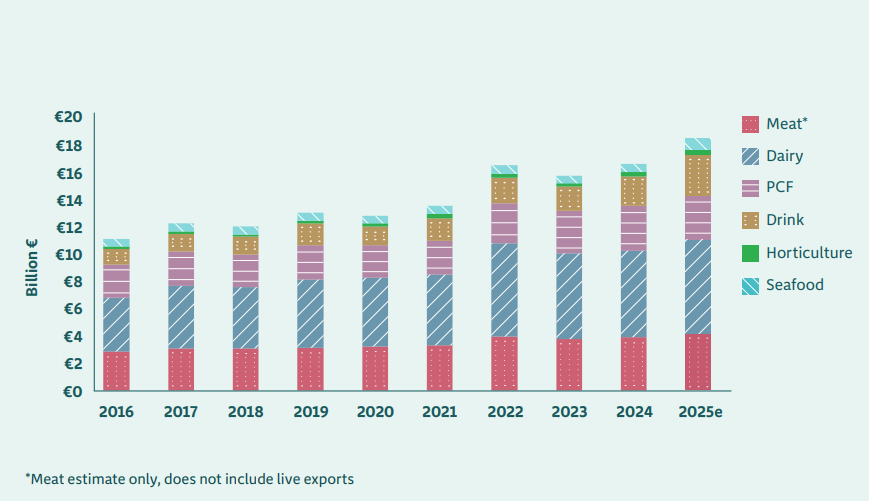
The 2025 report stated that Irish dairy exports were valued at a"record" €7.3 billion, with over 1.6 million tonnes of product shipped to approximately 140 markets worldwide.
According to Bord Bia, the total value of primary beef exports in 2025 was estimated to be €3.4 billion, up 24% on 2024, despite export volumes being 40,000t lower than the average recorded over the last decade.
Bord Bia highlighted that 2025 was a "challenging year for the Prepared Consumer Foods (PCF) sector, with businesses navigating persistent inflation and evolving consumer dynamics".
"Despite these pressures, exports grew by 9% to €3.6 billion."
Food sovereignty
This is not an Ireland-specific issue; in fact, the French Minister for Agriculture, Annie Genevard, has spoken out in the media in recent weeks in regards to France's food sovereignty.
Genevard said France must prepare "for the future by strengthening the resilience and sovereignty of our agriculture.”
She said: “The requirement that we ask of our French farmers must be the same for imported products."

She added: "We can no longer accept this unfair competition.
“Reclaiming our food sovereignty means being as less dependent as possible.
"However, we are not sovereign over fertilisers: this is why we will deploy a Fertiliser Plan in the coming weeks.
“We must be proud of our agri-food industries."
She went on to say that the French "must reduce our dependencies".
"We must reduce our fragilities in a world that becomes more and more uncertain, more and more eruptive.
"Anything that makes us dependent on others is maximum fragility," Genevard remarked.