Top 75 bulls on the Active Bull List are all Irish-bred

According to the Irish Cattle Breeding Federation (ICBF), the top 75 bulls on the ICBF Dairy Active Bull List are all Irish-bred for the first time in the programmes history.
The data, which was obtained during ICBF's March genetic evaluations, shows just how far Irish breeding has come.
ICBF highlighted how foreign bulls 'dominated' the active bull list for years, noting that there was only two Irish-bred sires on the list back in 2001.
Last year, there were 74 Irish bulls and only one New Zealand-bred bull, an origin that held strong within the list for years alongside US bulls.
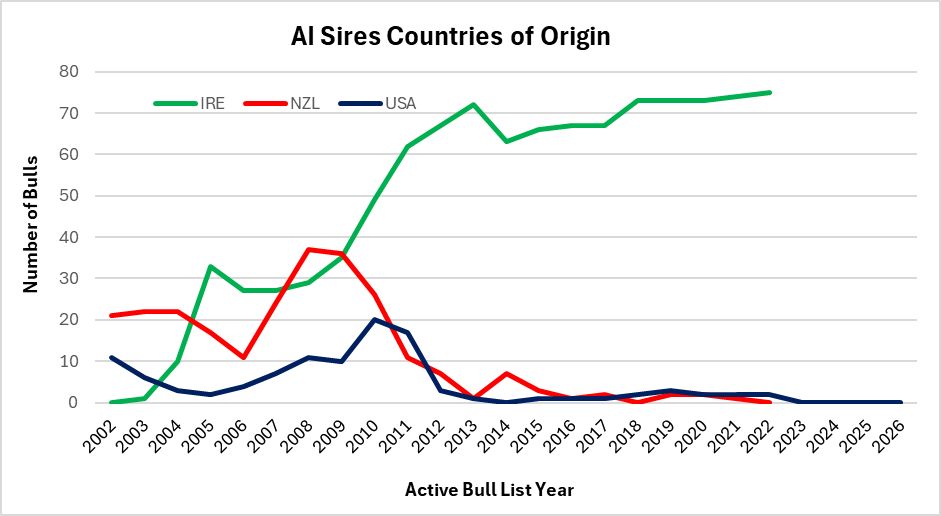
Now, there are 75 Irish bulls in a row, all boasting Economic Breeding Index (EBI) of €231 or higher.
In terms of EBI, there is a high of €291 on the list, while the top 75 average €249 in total.
ICBF confirmed that 73% of the bulls that are on the list are Genomic Bulls, with the remainder being Daughter Proven in Ireland (27%).
It has also been confirmed by ICBF that all of the bulls are genotyped, and none are a carrier of genetic defects such as complex vertebral malformation (CVM) or bovine leukocyte adhesion deficiency (BLAD).
The top 75 active dairy bulls are also now all Holstein/Friesians, after years of Jerseys or Jersey crosses making it onto the list in some capacity.
In 2025, there was three Jersey crosses alongside 72 Holstein/Friesians.
Active Bull List
For a bull to make its way on to ICBF's Active Bull List, it must be available from an artificial insemination (AI) company, meaning a farmer can actively buy semen from the bull.
Secondly, the bull must have an EBI reliability greater than or equal to 35%, and a calving difficulty reliability greater than or equal to 70% (based on 23% heifer rel% and 77% cow rel%).
Finally, the bull must have a calving proof, which means they must have least 50 Irish calving records.
As genetics consistently improve, there are young bulls out there that will have higher EBIs than those on the list; however, they will not yet have a calving proof.
But moving to one of these unproven bulls can be risky, as they may have a high EBI and pass all of the lab test for their semen, yet there could still be issues in terms of health and fertility.
That is why ICBF's active bull list can be a great tool to use when it comes to breeding, as they are essentially established within the dairy sector.
The top 20 bulls on ICBF's Active Bull List are outlined below:
| Bull Name | Code | EBI € | Supplier |
|---|---|---|---|
| CITYHILL LINCOLN SRM | FR8890 | 291 | Dovea |
| OLCASTLETOWN MOJO | FR8709 | 288 | NCBC |
| AGHERNBRIDGE BOROCCO SRM | FR9813 | 287 | Dovea |
| NEXTGEN GIRVIN SRM | FR9010 | 273 | NCBC |
| MILLTOWNBEG NAPIER SRM | FR9256 | 272 | Bova AI |
| KILDRINAGH IVANT | FR7257 | 272 | NCBC |
| GLENABOY ALLSTAR SRM | FR8893 | 271 | Dovea |
| CANDREW FREEDDIE 2040 SRM | FR9801 | 269 | Dovea |
| CARRIGLEAGH KINGMAN | FR7869 | 266 | NCBC |
| SHANTULLIG REUBEN SRM | FR8637 | 265 | NCBC |
| TINNAKILL GRANDSLAM | FR9016 | 264 | NCBC |
| KILTESKIN HITMAN SRM | FR9127 | 261 | Eurogene LIC |
| CLONDRINAGH SARSFIELD SRM | FR9943 | 260 | NCBC |
| HARTEFIELD SUPERDRY | FR7863 | 260 | NCBC |
| CLOCHRUA MESSI | FR9358 | 259 | Dovea |
| VADENHILL SHOEMARK SRM | FR9966 | 259 | NCBC |
| BARRADUFF BRÓD SRM | FR9100 | 258 | Eurogene LIC |
| TUREENDUBH ALASKA SRM | FR9406 | 258 | NCBC |
| BALLYMAGREE CANDY SRM | FR9804 | 258 | Dovea |
| BRIDEPARK KEMBOY SRM | FR7875 | 258 | NCBC |
In the current list, 55 bulls are Genomic Proofed (GS) while 20 bulls are Daughter Proofed (DP-Irl).
The active bull list has changed since farmers were breeding last year, as there has been changes to the base population of the EBI.
As well as that, some bulls have moved from a GS to a DP-Irl, as more progeny become available for testing.
The most notable change farmers may see is Tankardsrock Teak (FR7929) who previously held the top position on the ICBF Active Bull List, but has since dropped more than 200 places following a move from GS to DP-Irl.
These fluctuations in bull proofs can be common, and highlight the importance of having a large bull team.
The advice is to have no more than 15% of heifer replacements coming from one single bull in a bid to mitigate genetic and fertility risks.