Spring grazing: Conditions shaping up countrywide

Spring grazing is finally taking shape following a couple of good days of sun, and the good news is Met Éireann is forecasting the dry spell to extend right into next week.
Up until recently, the weather had made quite a messy situation out of this year's spring grazing.
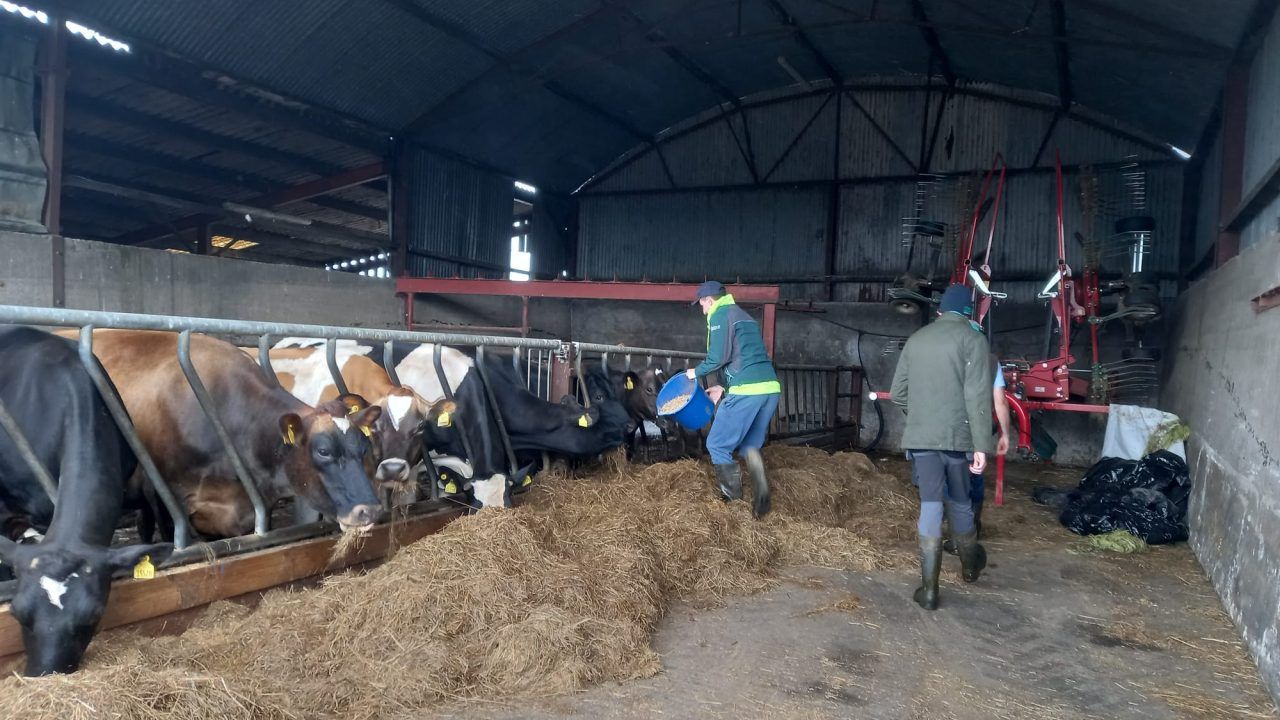
As recently as last week, some herds were sailing into their second rotation, others had finished the first rotation but did not have the grass for the second, while more were still housed with only the odd day at grass, if any.
Grass growth has been slow on most farms this spring but is starting to pick up in recent weeks, with grass growing at an average rate of 45kg dry matter (DM)/ha/day last week, according to PastureBase Ireland.
This spell of good weather and growth should let farms get set up for summer rotations, aiming for full time out on 21-day rotations in May.
Current situation
Currently, farms should be targeting an average farm cover (AFC) of roughly 700kg DM/ha, or 180-200kg DM/livestock unit (LU).
According to PastureBase Ireland, 30% of farms are under this target, while 42% are exceeding it, and the remaining 28% are on target.
This clearly represents how challenging spring grazing has been so far this year.
The over-target farms have a mean AFC of 894kg DM/ha, showing many farms are only starting to graze now.
These farms will be faced with plenty of decisions in terms of managing surplus grass in the next few weeks.
Ideally they need to be pushing to get cows out to grass on a full-time basis, looking for good clean-out residuals of 4cm.
It may be worth considering letting additional stock such as yearlings and stock bulls out to graze too.
On top of that, paddocks that have gone too strong should ideally be taken out of the rotation and put aside for silage in a couple of week's time.
For on-target farms, grass allocations can be kept in or around the 24-36 hour mark, but must be adjusted accordingly in line with rotation planners and grass wedges to suit intakes.
Allocations
In order to work out what your paddock size should be, farmers should use the following calculation:
Cow numbers X 19kg of grass (may vary between herds) X 1.5 days = cow requirement for three grazings ÷ 1,400 (pre-grazing yield) = the size of paddock in hectares to accommodate three grazings.
Example: 120 cows X 19kg DM grass X 1.5 days = 3,420 ÷ 1,400kg DM/ha = 2.44ha paddock required.
A 36-hour paddock is the ideal target but is sometimes impossible due to farm layout, etc., but farmers should be aiming for either 24 hours or 36 hours and not in-between to allow for full herd nutrition.
Target paddocks with a pre-grazing cover of about 1,400kg DM/ha when the sward is green from top to bottom to ensure grass quality and regrowth.
At a pre-grazing cover of 1,400kg DM/ha, the grass plant should still be at the two to three leaf stage. If the grass starts growing the fourth leaf, the rotation is getting too long.
Even though we are just coming off the back of a very wet season, grass growth will pick up rapidly.
Therefore walking the farm twice a week is crucial to make timely decisions and ensure covers do not get out of hand, as a 1% reduction in grass digestibility can reduce milk solids yield by 1-2%, which will be felt in milk cheques, which are already tight as it is.