Industry calls for simple and 'cost-effective' carbon farming framework


Industry has called for a "simple, farmer-friendly and cost-effective" carbon farming framework.
Minister for Agriculture, Food and the Marine, Martin Heydon has today (Wednesday, May 20) published a report on the public consultation on a draft set of principles to develop a National Carbon Farming Framework.
It follows a public consultation launched by the minister last year.
Carbon farming aims to support and enable the adoption and scaling of management practices within agriculture that support sustainability credentials, as well as supporting Ireland in achieving environmental targets.
There is a commitment under the programme for government and the Climate Action Plan to develop a National Carbon Farming Framework.
Consultation response
Minister Heydon said: "I am very pleased with the overall response and engagement from stakeholders in this process.
"My priority is to engage with stakeholders in the development of new policy, and this consultation has provided my department with valuable feedback and recommendations to inform the development of a National Carbon Farming Framework."
The public consultation generated 59 submissions with three key stakeholder workshops (200 attendees) also conducted.
The biggest response (32%) came from foresters/forest owners (including duplicated submissions) followed by farmers/farmer organisations (22%), the department said.
Opportunity
The report published today said that respondents "acknowledged Ireland’s strengths as well as areas for development" with a strong demand for "greater policy coherence and need for simplification and reduction of the administrative burden".
The report also outlined: "It was acknowledged that Ireland is well-placed to become a European leader in carbon farming, supported by strong national datasets, farm advisory capacity, and scientific expertise.
"Stakeholders recognised the great opportunity to incorporate livestock methane mitigation in the framework."
Minister Heydon said his ambition is to develop a framework that will "give guidance to farmers, foresters, and landowners whilst providing confidence to those wishing to invest in carbon farming".
"The consultation sought input from stakeholders to shape a framework that can potentially diversify farm incomes.
"The feedback provided on the publication of a draft set of principles will continue to inform policy development at a national level," he said.
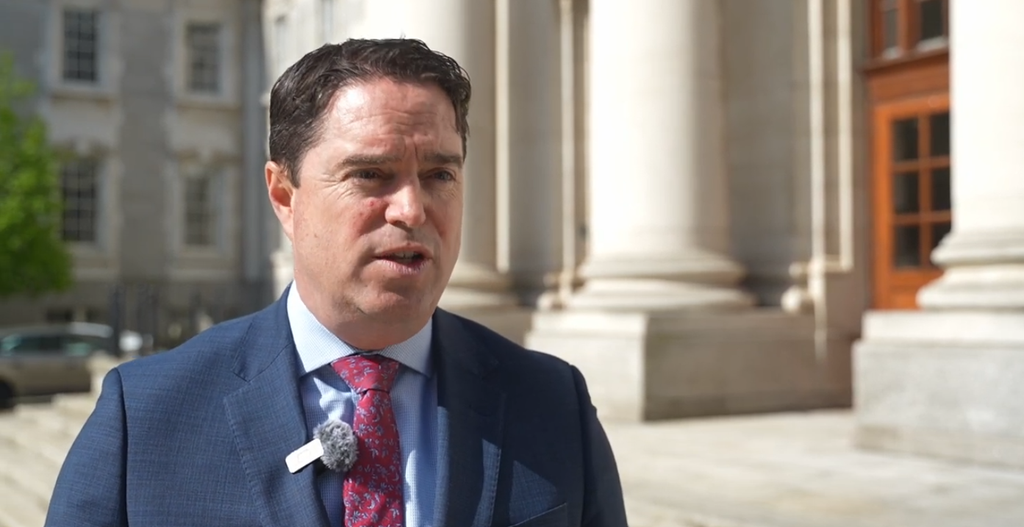
However, Minister Heydon said he is conscious there are developments at EU level under the Carbon Removal and Carbon Farming Certification Regulation (CRCF).
"It is important that any framework we develop aligns with the development of the CRCF regulation," he said.
Minister Heydon will shortly convene an "extended working group of stakeholders, to include all farm bodies", to discuss the development of the National Carbon Farming Framework.
"I echo stakeholder feedback in saying that a successful framework must be simple, farmer-friendly, environmentally-sustainable and cost-effective," he added.
Recommendations from the consultation
Following the public consultation and stakeholder events, a number of recommendations were compiled.
The report identifies the first as the development and delivery of a National Carbon Farming Framework.
Feedback from stakeholders identified the commitment under the Climate Action Plan and programme for government to develop a National Carbon Farming Framework as a "key enabler to build confidence and guidance to the establishment of a suite of activities to deliver carbon farming in Ireland".
A second key recommendation is to develop and implement a demonstration initiative to guide learning and scaling.
"There is an identified need for a National Carbon Farming Framework to function to co-create a new model of Irish agriculture - one that strengthens and protects the family farm model, while uniting environmental responsibility with economic output," the report said.
"Carbon farming must complement, not replace productive agriculture.
"The development of a carbon farming framework requires testing through a large-scale demonstration initiative that can test approaches on different farm types, and which will ultimately build confidence on both the farmer and buyer sides of the market.
"This should integrate existing initiatives and deliver robust evidence for industry, policymakers and farmers to inform what sustainable agriculture will look like in Ireland in 2030 and beyond."
Governance
It was also considered that a governance board should be formed with representative stakeholders.
In addition, it has been recommended that a technical committee should be established to ensure consistency in the rules or standards used, and that there is alignment with the Carbon Removal and Carbon Farming Certification Regulation.
There is also a strong consensus that an Irish registry should be established by governmental organisations designed from the start to be interoperable with the future Union Registry (to be developed by the Directorate-General for Climate Action by 2028).
"This national registry can be a key lever to strengthen market integrity and build confidence and trust in carbon farming in Ireland by ensuring transparency, integrity and sending a clear investment signal for farmers and project developers," the report said.
Main barriers
Based on the consultation process, a number of main barriers to the successful development of carbon farming in Ireland were identified.
These include: policy certainty - interoperability with the Common Agricultural Policy (CAP) and public schemes; financial and income risk including liability and permanence concerns; and complexity and administrative burden.
Market uncertainty and advisory and technical capacity were also identified.