How Ireland stacks up on farm fuel support in the EU

Fuel costs are squeezing farm incomes across Europe, prompting targeted supports—but how does Ireland’s package stack up against the rest of the EU?
In an effort to combat the global rise in fuel prices, European governments have committed almost €10.46 billion in fiscal measures to ease the pressures.
The disruption in the Middle East, causing the closure of the Strait of Hormuz, through which around one-fifth of global liquified natural gas (LNG) trade transits, has increased oil and gas prices exponentially.
The International Energy Agency (IEA) described the disruption as the "largest supply disruption in the history of the global oil market.”
According to the Department of Agriculture, Food and the Marine (DAFM), green diesel increased from around €0.97/L in late February to €1.80/L in early April.
Meanwhile the European economic think tank Bruegel has outlined that European governments have committed almost €10.46 billion in fiscal measures to cushion the impacts of the Middle East conflict on energy bills.
Bruegel said that, in absolute numbers, “Spain and Germany have committed by far the most, with Spain alone accounting for almost half of the total."
As a share of GDP, Spain, Bulgaria, Greece and Ireland are “the frontrunners", Bruegel stated.
Ireland
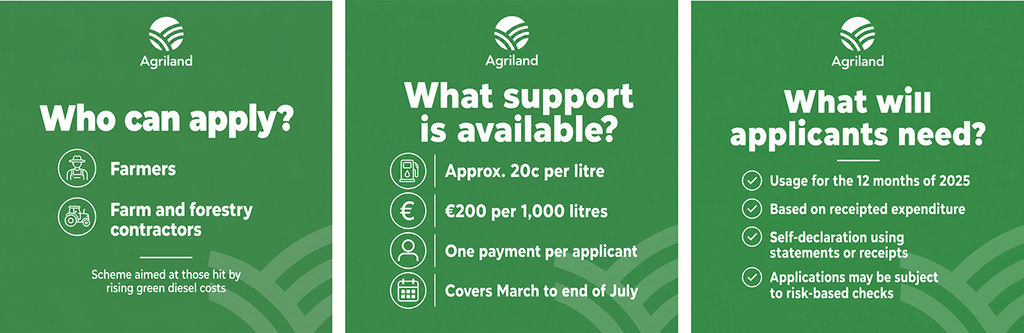
Ireland’s “comprehensive” €100 million Fuel Subsidy Support Scheme, announced on April 12, delivers a rebate of approximately 20c/L of green diesel used, based on verified fuel consumption in 2025.
The payments will cover the months of March up to the end of July, which “coincides with peak fuel usage on farms”.
The scheme will provide €20 million per month to those in supports - approximately 120,000 farmers and 1,500 full-time agricultural contractors.
Under the scheme, which will be open for applications next week, there will be one payment per applicant to cover a full five-month period rather than monthly payments.
Minister for Agriculture, Food and the Marine, Martin Heydon outlined that “this approach ensures that funding is directed where it is needed most, helping to sustain essential food production and rural economic activity”.
The support is in addition to the full removal of all non-carbon excise on green diesel, worth approximately 7.5c/L.
These supports, totalling some 27.5c/L, exceed by almost 6c/L the entirety of excise charged on green diesel prior to the conflict in the Middle East.
The broader government package which totals €505 million, also included a further 2.4c/L excise cut on marked gas oil, postponement of the May carbon tax increase, and a Road Transporters Support Scheme.
Spain
Within weeks of the Iranian conflict beginning, Spanish Prime Minister Pedro Sánchez's government implemented a €5 billion package which focused on significant energy tax cuts.
The key element for most consumers was a reduction in VAT from 21% down to 10% on all energy, including motor fuels, electricity, natural gas and butane, which cut petrol and diesel prices by up to 30c/L at the pump.
For farmers, hauliers and fishermen, Spain added a direct fuel subsidy of 20c/L on professional fuel, on top of the broader VAT cut.
The government also provided a one-off automatic financial aid to farmers to offset fertiliser price increases, a separate measure that Ireland has not matched.
However, the European Commission has questioned whether Spain's VAT cuts on motor fuels are compatible with the EU VAT Directive, but the measures remain in force.
Germany
Germany's response to the surge in fuel prices has centred on a broad excise duty cut of 17c/L on both petrol and diesel as announced by Chancellor Friedrich Merz for May and June in response to soaring pump prices.
Federal Minister of Agriculture, Food and Regional Identity of Germany, Alois Rainer said the two-month measure would benefit farmers directly, stating that "lower costs for petrol and diesel ease the pressure on agriculture and have an effect along the entire food production chain up to the supermarket shelf".

The German government has not introduced an agriculture-specific fuel subsidy scheme.
Getting only around 6% of its crude oil from the Middle East, petrol and diesel are mainly produced in Germany from imported crude oil from the Netherlands, the US, Norway and Belgium.
Since 1 April, petrol stations in Germany have only been allowed to increase their fuel prices once a day at 12 noon, while price reductions will be permitted at any time. Previously, the price of petrol changed up to 22 times a day on average.
The new rule ensures reliability and greater transparency for drivers and commuters.
France
France suspended all excise duties on green diesel for the month of April, a measure worth approximately €14 million.
This was accompanied by a €70 million package covering transport, agriculture and fisheries, delivering 15c/L of non-road agricultural diesel, 20c/L in subsidies for small logistics companies, and 20c/L reimbursements for fishing boats.
A further "exceptional support" measure of €20 million was then targeted specifically at the most fragile farms facing cash flow emergencies.

The French government will also spend €50 million to subsidise 20c/L for trucks operated by small logistics companies most affected by high prices, while fishing boats will also benefit from a reimbursement of 20c/L for a total cost of €5 million.
France also provided a €500 million package of state-guaranteed consolidation loans, deferrals of social security contributions, and deferral of tax deadlines for agricultural businesses.
Minister of Agriculture, Agri-Food, and Food Sovereignty of France, Annie Génévard has repeatedly called for the EU’s Carbon Border Adjustment Mechanism (CBAM) for fertilisers to be suspended.
Overall, the French government has provided almost €90 million in direct supports for farmers since the beginning of the crisis.
Italy
Italy introduced tax credits for agriculture rather than a per-litre approach.
The country’s response to the crisis has included temporary excise duty cuts on fuel worth €417 million, alongside sectoral tax credits for road hauliers of €100 million.
Like its French counterparts, Italy has continuously requested a suspension of CBAM measures at EU level to help alleviate pressures on farmers.
The Italian Council of Ministries announced a tax credit of €30 million to cover the purchase of fuel for the month of March at the rate of 20% and have extended the reduction in excise duties on fuel until May 1.
Minister of Agriculture, Francesco Lollobrigida described the measure as “a concrete support for the primary sector in Italy.
“Our farmers will be able to cushion the increases in the cost of fuel needed to produce” he added.
Greece
Greece's €300 million response to the crisis has included a 15% subsidy on fertiliser purchases for farmers until August.
The government introduced diesel subsidies at distribution points of 16c/L, translating to an estimated 20c/L benefit for consumers and businesses after VAT.
A monthly digital fuel wallet for vulnerable households was also introduced by the government.
As reported by Agriland on April 1, this support comes after an EU investigation into Greek agri-fund frauds, where several current members of the Greek national parliament were allegedly involved in a scheme to defraud previous agricultural funds.