Steps to Superior Silage
Treating Silage
Can making silage with an additive improve animal performance?
Across a range of forages and dry matters, Lactobacillus plantarum MTD/1 (the bacterial strain in Ecosyl) has been shown to improve milk yield by an average of an extra 1.2L per cow per day across 15 independent dairy trials, compared with feeding untreated silage.
Across 19 independent beef trials, Lactobacillus plantarum MTD/1 has also consistently produced more beef – with liveweight gain in growing cattle increased by more than 11% in 10 trials, and carcass gain in fattening cattle increased by more than 9% in nine trials.
Can a silage additive be seen working?
Although an additive cannot ‘directly’ be seen working, Volac scientists have used DNA fingerprinting (a technique used in forensics) to provide an insight into this.
By using DNA fingerprinting, the scientists were able to produce an image (see picture below) where horizontal bands represent the DNA of the different bacteria present in silage at 0, 3, 7, and 91 days after ensiling, both with and without Ecosyl applied.
Darker banding indicates more of that bacteria being present.
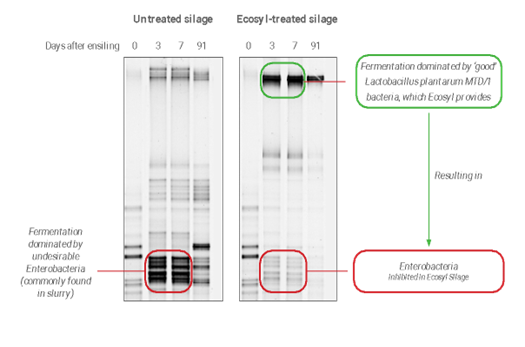
Where silage was untreated (left), results revealed that during the early part of the fermentation in particular, the silage was dominated by undesirable enterobacteria, commonly found in slurry.
Where Ecosyl was used (right), there was very little growth of enterobacteria, as the ‘good’ bacteria present dominated the fermentation, with the clearly visible result that the undesirable bacteria were inhibited from growing.
Can an additive stop grass silage heating?
Unfortunately, no matter how efficient the fermentation, it cannot inhibit all microorganisms.
Certain yeasts can survive in low pH conditions and feed on lactic acid when exposed to air.
This reduces the silage’s dry matter (DM) and energy through the production of carbon dioxide and release of heat in the process of aerobic spoilage (heating).
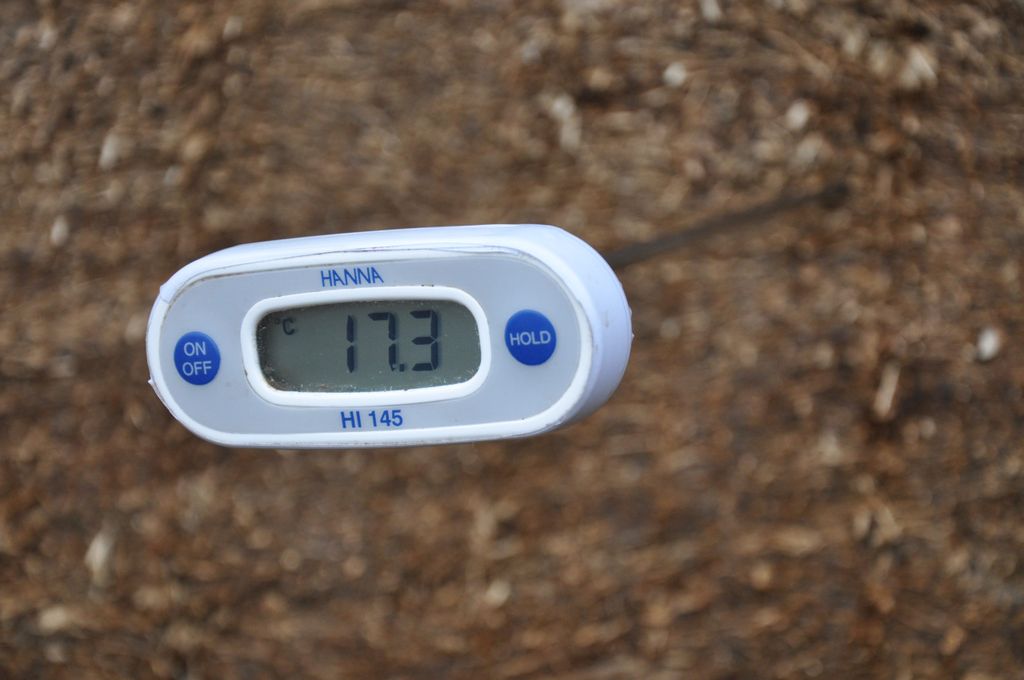
This is a particular problem in higher %DM forages that are more difficult to consolidate.
As the yeasts use up lactic acid, the pH rises again, allowing other undesirable fungi to grow.
Other consequences include reduced palatability and potentially production of mycotoxins.
Farmers have little control over the numbers of yeasts on the crop, but what is possible is to limit their growth on the silage.
As well as practices such as consolidating and sealing clamps well, a dual-acting inoculant can help.
The dual-acting inoculant Ecocool contains a tailored dose of the same proven Lactobacillus plantarum MTD/1 found in Ecosyl for fermentation, but blended with a second bacterial strain, Lactobacillus buchneri PJB/1.
This second strain generates acetic acid, which has anti-yeast properties.
Ecocool has been shown to both reduce yeast levels and keep silage cool and stable for more than 10 days on exposure to air.
Should an additive be used on low sugar grass?
Grass can often be low in sugars and/or have low numbers of beneficial lactic acid-producing bacteria present on it.
Use of a proven additive helps to counteract these to drive a more successful fermentation.
If sugar is limiting, a stable pH value may never be reached.
This can allow other very undesirable bacteria, e.g., clostridia, to take control, changing a poor fermentation into a very bad fermentation with a much-reduced nutrient value and high losses.
Should an additive be used on low dry matter grass?
With low dry matter (<20% DM) grass, an additive is usually considered essential, especially if harvesting conditions are not ideal and/or the grass has a high clover content.
This is because very wet grass silage stabilises at a lower pH and the acid produced is diluted so more acid is needed. This means more sugar is also needed and a minimum of 3% (fresh basis) used to be recommended.
However, if an effective additive is applied, it may be possible to get away with less sugar as the sugars are used more efficiently.
How can I trust a silage additive?
Two ways. Ask to see scientific proof that it works. And secondly, look at the quality of the product and how it is made.
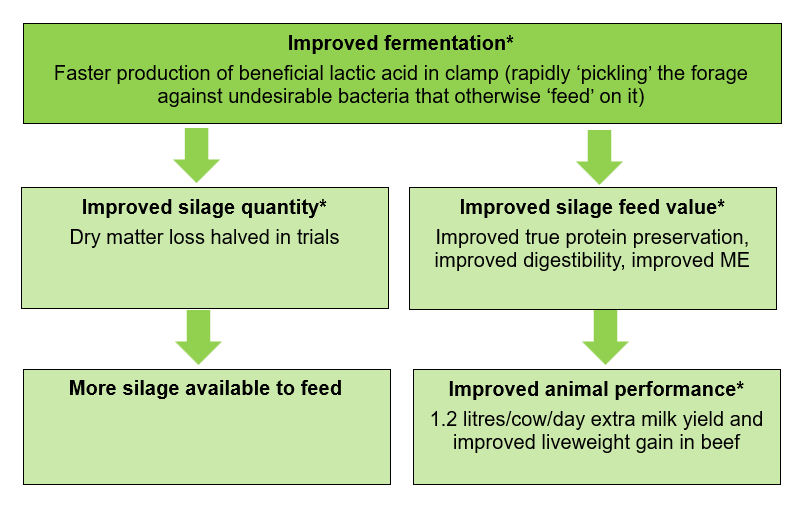
With Lactobacillus plantarum MTD/1, there is a huge amount of research to pinpoint the logical sequence of benefits the treatment brings – from application right through to animal performance (see graphic below).
MTD/1 (in Ecosyl) – tested extensively
- More than 200 fermentation trials;
- Intake/digestibility/ME feeding trials;
- Animal performance trials.
Sequential benefits of Lactobacillus plantarum MTD/1 treatment based on research
For this 'Steps to Superior Silage', Agriland Media Group and Ecosyl are joining forces ahead of the upcoming silage season, aimed at bringing farmers and contractors tips on producing superior fodder.