Fewer cattle and less fertiliser could cut farm emissions by 19%


Total emissions from the agriculture sector could fall by up to 19%, according to a new report from the Environmental Protection Agency (EPA) today (Wednesday, May 27).
These projections are based on the Irish Government's planned climate policies and measures up to 2030.
Based on the implementation of these policies and measures the EPA has estimated that total emissions from the agriculture sector "will decrease between 4% and 19% over the period of 2018 to 2030".
According to the EPA the decrease in emissions from the agriculture sector will be driven by changes in nitrogen fertiliser use, a shift towards alternative fertilisers, and expected reductions in livestock numbers.
Research shows that agriculture greenhouse gas (GHG) emissions come mainly from "enteric fermentation" - methane produced by ruminant livestock, manure management and nitrogen fertiliser.
But fuel combustion from agriculture, forestry and fishing also factor into the figures, the EPA has highlighted.
Based on the latest GHG Inventory (1990-2024) agriculture emissions in 2018 were 21.4 Mt CO2 eq.
The sector has an emission reduction target of 25% by 2030compared to 2018.
The change in projected agriculture emissions is primarily due to revisions in the base GHG inventory (1990-2024) which resulted in lower overall projected emissions from 2025-2030.
Emissions
The latest EPA report examines potential GHG emissions under two different scenarios - With Existing Measures (WEM) and With Additional Measures (WAM).
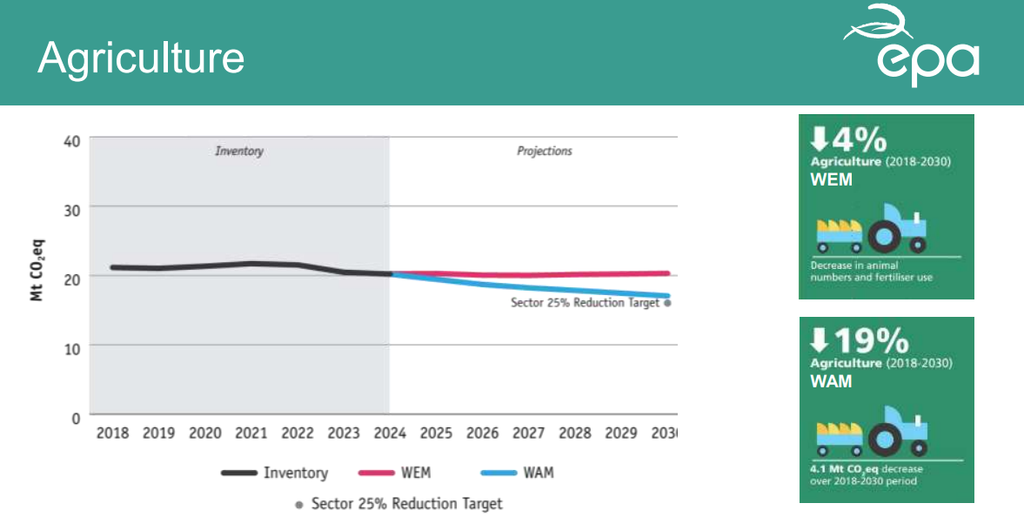
Total emissions from agriculture are projected to decrease by 4% from 21.4 to 20.5 Mt CO2eq in the WEM scenario over the years 2018 to 2030. This decrease would be chiefly driven by fewer cattle and lower fertiliser use.
If this scenario plays out the sector is projected to contribute 36.6% of Ireland’s total emissions in 2030.
But under the WAM scenario emissions could decrease by 19% from 21.4 Mt CO2eq in 2018 to 17.3 Mt CO2eq by 2030.
A greater decrease in emissions, according to the EPA, would be driven by manure management measures, increased adoption of protected urea, annual limits on chemical N fertiliser, reduction in animal feed crude protein, earlier finishing of beef cattle and the use of methane inhibitors.
In this scenario the sector is projected to contribute 35.9% of Ireland’s total emissions in 2030.
LULUCF
Meanwhile in the latest EPA report GHG emissions from the Land Use, Land-Use Change, and Forestry sector (LULUCF) are projected to increase between 4% to 72% over the period of 2018 to 2030 as Irish forestry "reaches harvesting age, and shifts from being a carbon sink to a source of emissions".
However, planned policies and measures for the sector, including increased afforestation, water table management on agricultural organic soils and peatland rehabilitation are projected to "reducethe extent of the emissions increase" according to the EPA.
Regardless of this the agency has warned that Ireland is unlikely to meet its European commitments in this area.
In general the latest EPA outlines that Ireland’s overall GHG emissions could fall by up to 25% by 2030 - compared to a national target of 51%.
It has forecast that while Ireland will be close to meeting the first carbon budget, nearly all sectors are on track to "exceed their sectoral emissions ceilings for the second carbon budget by 2030".
Dr. Eimear Cotter, EPA director general, has warned that while the agency's projections suggest GHG emissions can be reduced in Ireland, European and national emission reduction targets are projected to be missed.
"There must be a renewed focus on delivering the actions to meet Ireland’s climate targets which will be a significant challenge given the short timeframe to 2030," Dr. Cotter said.