EU butter production up 6.3% in 2025 - report

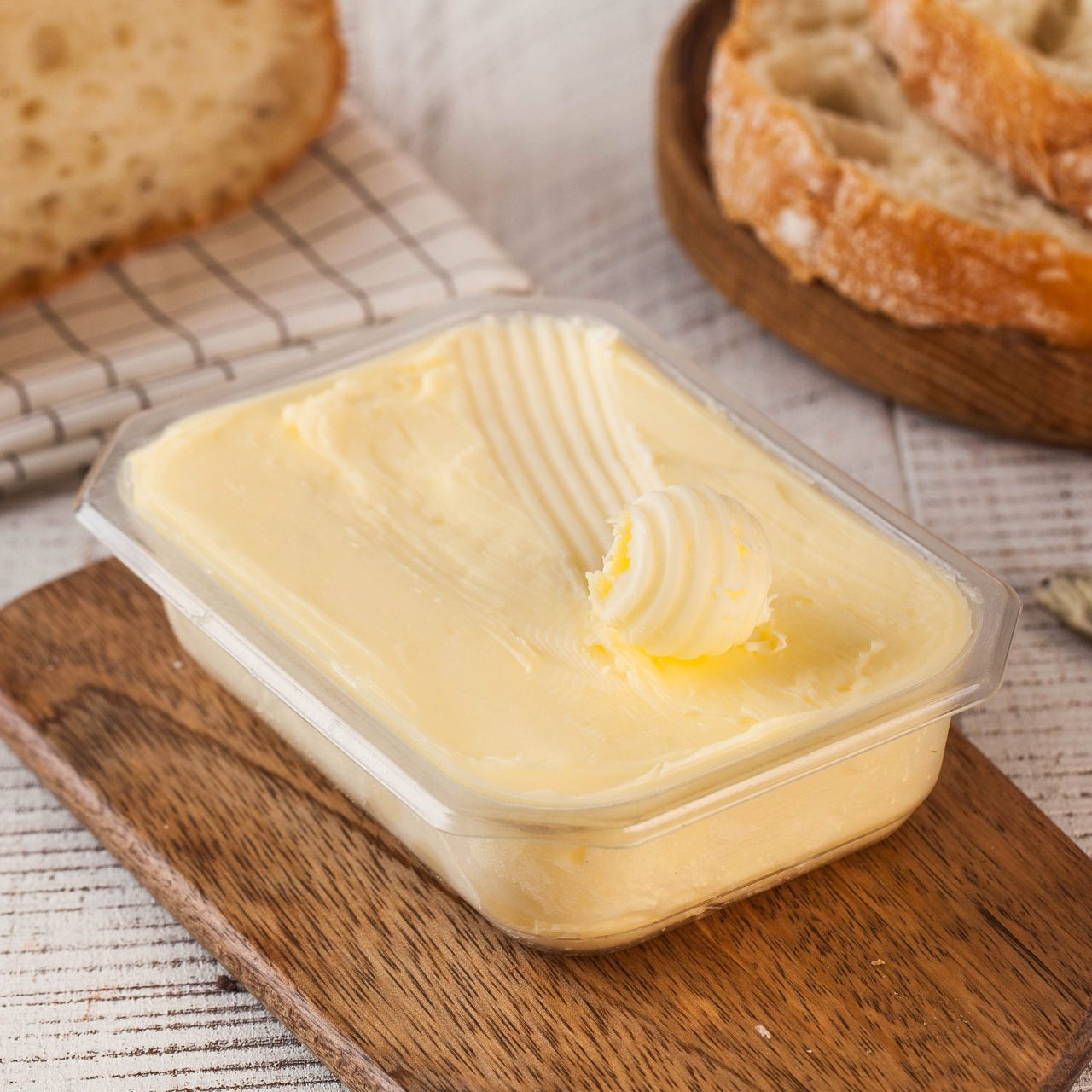
EU milk production increased 1.64% in 2025 year-on-year, while while butter production expanded by 6.3%, according to a new study.
However, there were signs of contraction in the cream market, according to data from Dutch firm DCA Market Intelligence.
A key finding of the report is that higher valuation drove butter production growth, but only at the margins.
It said: “The EU dairy system operates under the strategic allocation of milk into diverse products to maximise profits.
“Under normal conditions, milk supply remained broadly stable and restricted, with annual changes ranging between -0.1% and +0.2%.
“This changed notably in 2025, when the annual growth in milk output reached 1.64%.
“Under unusual surplus conditions, regional milk allocation shifted notably towards butter production, increasing by 6.3% year-over-year to 2.22 million (metric tonnes) in 2025.”
The report found that, among the milk fat products, “butter observed a higher valuation compared to cream”.
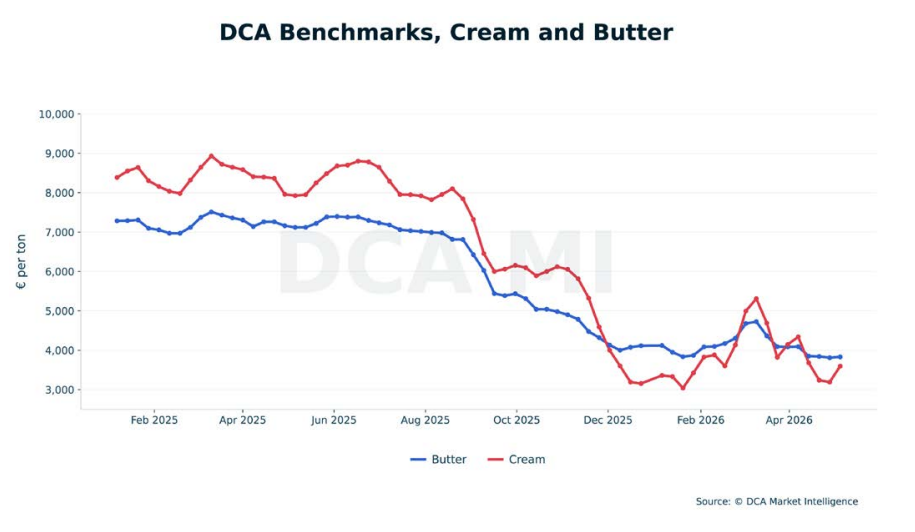
On the subject of cream, the survey found that the product “became a residual and volatile market, facing a structural disadvantage amid the milk surplus”.
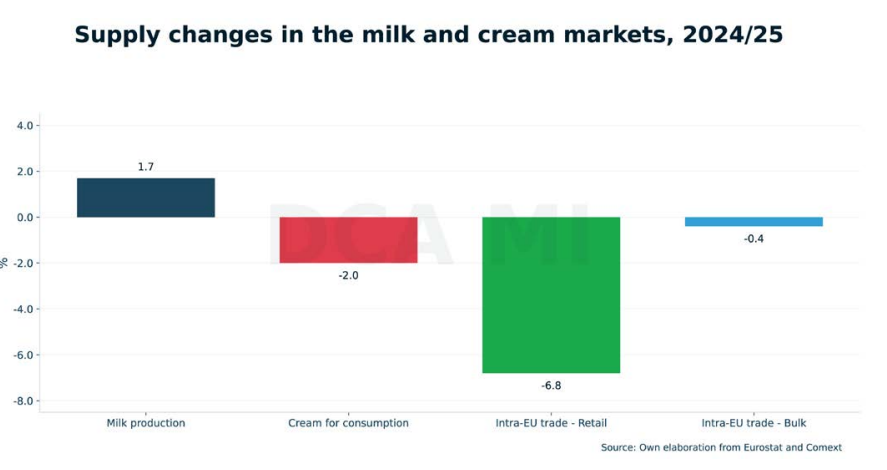
It said: “While the pace of butter production increased beyond the milk output, signals pointed to a contraction in the cream market, including a 2% year-over-year decline in the production of cream for consumption and a decline in the trade of cream within the EU bloc.
“This implies that the increased supply of milk was diverted away from cream production.”
According to the report, the EU internal butter market absorbed the surplus, but this is "fully insulated”.
“Despite the accelerated pace of butter production growth, exports have not expanded accordingly," the report said.
“Butter exports remained broadly stable over the previous year (-0.3%) and have even contracted over 2020 (-8.8%).
“The EU also reported a contraction in trade within the bloc, falling by 0.7% between 2024 and 2025.”
It added that there has been "a constant decline in the retail segment over the last few years” for butter, a trend that continued in 2025 with a contraction of 10.2%.
The behaviour of bulk and retail butter markets is “fundamentally different”, the report found.
It said: “Within the EU bloc, the trade of retail packaged butter has shown signs of saturation, observing a steady contraction since 2020.
“In contrast, the bulk butter trade saw steady growth, increasing by 2.9% to 572,554t.
"Butter in this segment can be either repackaged or included in a wide variety of products in the food service and food industry.”
Bulk butter exports
According to the report, in the international market, “the EU has been shifting away from bulk butter exports", which were reported as 83,971t in 2025.
It added: “This represented a steady contraction of 35% compared to 2020 and of 4.7% over 2024, while higher export volumes were reported by the US (+130% year-on-year or YoY) and New Zealand (+7.7% YoY) in 2025, highlighting the increased competition perceived in international markets.
“EU-sourced butter was also substituted in price-sensitive market destinations, such as Indonesia (-51.4% YoY).”
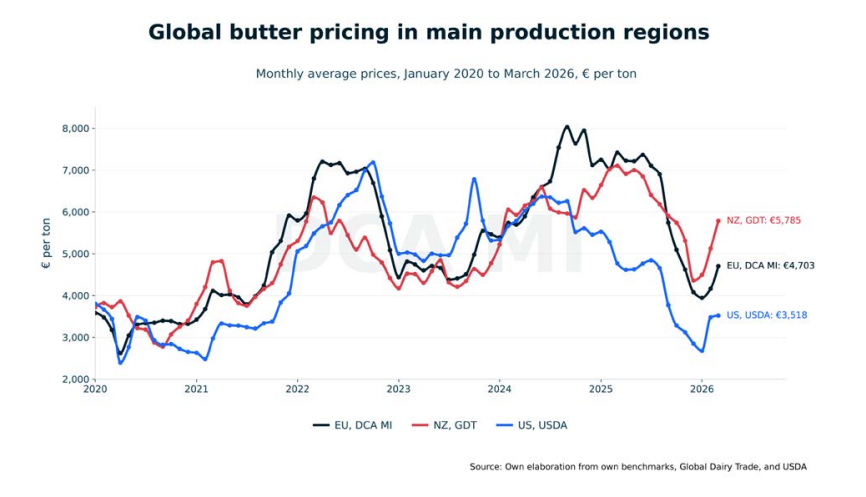
Finally, the report found that while global price trends influence EU butter prices, regional fundamentals "remain decisive”.
It said: “The mechanism of price formation in the EU butter market remains subject to several uncertainties.
“In practice, structural differences between regions appear to limit the extent to which global signals are reflected in the EU market.
"For instance, US butter has remained cheaper than EU butter for a prolonged period without fully translating into lower EU price levels.
"Similarly, New Zealand exports are largely directed toward Asia, reducing their direct influence on the European market.”