CSO: Nitrogen in fertiliser sales rose 13% in 2025

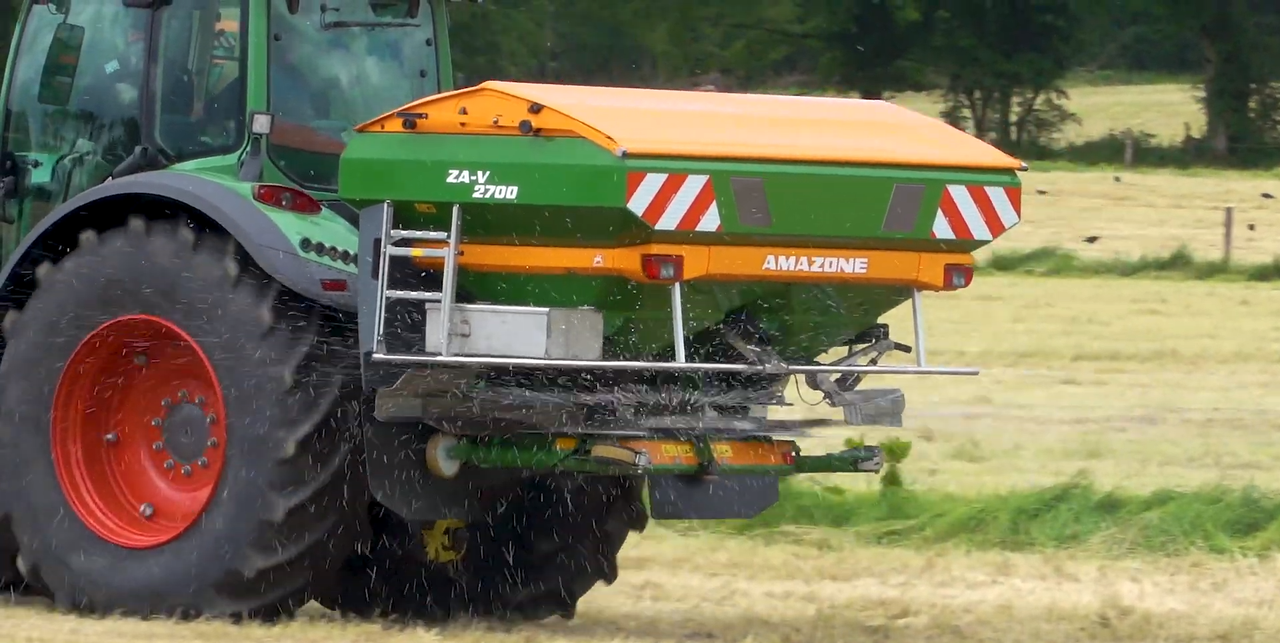
The nitrogen content of mineral fertilisers sold in the 2025 crop year (October 2024 to September 2025) was 349,293t, 13% higher than the 2024 crop year (October 2023 to September 2024).
That's according to the latest publication from the Central Statistics Office (CSO) published today (Friday, April 17).
The phosphorus content of mineral fertilisers sold in the 2025 crop year was up 13% on the 2024 crop year, at 32,556t.
Between the 2017 and 2025 crop years, the stabilised urea fertiliser share of total nitrogen content in mineral fertiliser sales rose from 0.5% to 15%.
The use of stabilised urea fertilisers in place of fertilisers that do not contain stabilised urea can reduce air pollutant and greenhouse gas (GHG) emissions, according to the CSO.
Mineral fertiliser sales
Total mineral fertiliser sales rose by 15% in the 2025 crop year to 1.4 million tonnes.
In the 2025 crop year, 84% of mineral fertiliser sales took place in the six months between January and June 2025.
Imports of mineral fertilisers rose 22% to 1.7 million tonnes in calendar year 2025.
Lime sales were 0.9 million tonnes in calendar year 2025, down 9% when compared with 2024.
Commenting on the release, statistician in the Environment Division at CSO, Clare O'Hara said: "Fertilisers are added to soil to provide crops with nutrients such as nitrogen and phosphorus.
"These nutrients enhance crop production but can also be lost from agricultural soil to groundwater, surface water, and air, contributing to environmental pollution.
"In the 2025 crop year, total mineral fertiliser sales rose by 15% to 1.4 million tonnes.
"This followed a rise of 8% in the 2024 crop year, after decreases of 18% in each of the previous two crop years."
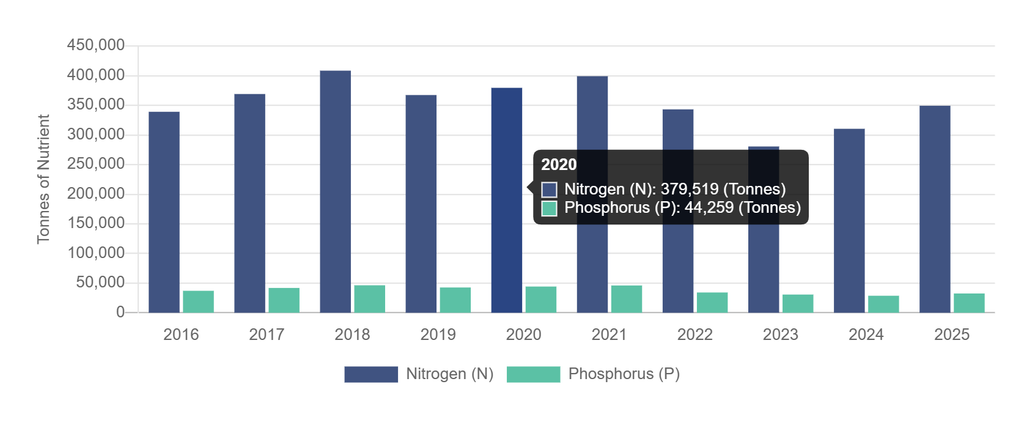
According to the CSO, the nitrogen content of stabilised urea fertiliser sales was up by around 50,000t over the period, while the nitrogen content of other fertiliser sales was down by around 70,000t.
Seasonal sales
According to the publications, quarterly sales data may give an indication of the time of year of greatest fertiliser use.
For each crop year from 2016 to 2025, at least 75% of mineral fertiliser sales took place between January and June.
In the 2025 crop year, 48% of mineral fertiliser sales took place in January to March 2025 while 36% were in April to June 2025.
Loss of nutrients to the environment is affected by the amount of rainfall at the time of fertiliser application.
Imports and exports
The CSO publication also contains data on imports and exports of mineral fertilisers by calendar year for the period 2016 to 2025.
Imports were highest in 2018 at 1.8 million tonnes.
Decreases in 2021, 2022, and 2023 saw imports fall to their lowest level in 2023 at 1.1 million tonnes.
A rise of 24% in 2024 and 22% in 2025 brought the volume of mineral fertiliser imports to 1.7 million tonnes in 2025.
Lime sales were 0.9 million tonnes in 2025, down 9% on 2024.
While applying lime to soil leads to carbon dioxide (CO2) emissions from the carbon content of the lime, the CSO stated that it can reduce requirements for nitrogen, phosphorus and potassium fertilisers, resulting in an overall reduction in greenhouse gas emissions.