Beef kill: Weekly cattle supply up 9% but cumulative kill down over 10%

Latest factory beef kill figures show that the weekly beef kill numbers are up on the corresponding weeks of last year but the total kill-to-date this year remains significantly below 2025.
A total of 31,380 head of cattle were slaughtered at Department of Agriculture, Food and the Marine (DAFM)-approved facilities in the week ending Sunday, May 24.
Last week's beef kill was up 2,579 head or 9% on the same week of last year, according to DAFM figures.
The table below details weekly beef kill numbers in the week ending Sunday, May 24, versus the same week of last year, the cumulative beef kill-to-date this year versus the same week of last year, as well as the change in numbers and percentage changes:
| Animal Type | Week ending May 24 2026 | Same week of 2025 | Change | Cumulative 2026 | 2025 Cumulative | Cumulative Change |
|---|---|---|---|---|---|---|
| Young Bulls | 2,221 | 2,009 | +212 (+10.6%) | 48,420 | 48,378 | +42 (+0.1%) |
| Bulls | 662 | 539 | +123 (+22.8%) | 9,559 | 10,068 | -509 (-5.1%) |
| Steers | 12,060 | 11,249 | +811 (+7.2%) | 243,738 | 266,467 | -22,729 (-8.5%) |
| Cows | 6,797 | 6,059 | +738 (+12.2%) | 135,452 | 162,817 | -27,365 (-16.8%) |
| Heifers | 9,640 | 8,945 | +695 (+7.8%) | 207,930 | 235,543 | -27,613 (-11.7%) |
| Total | 31,380 | 28,801 | +2,579 (+9.0%) | 645,099 | 723,273 | -78,174 (-10.8%) |
Last week marks the third consecutive week that 2026 weekly beef kills have been higher than the corresponding weeks of last year.
Until late April of this year, weekly kill numbers had been trending below last year.
The graph below shows how weekly beef kill numbers have been trending compared to last year:
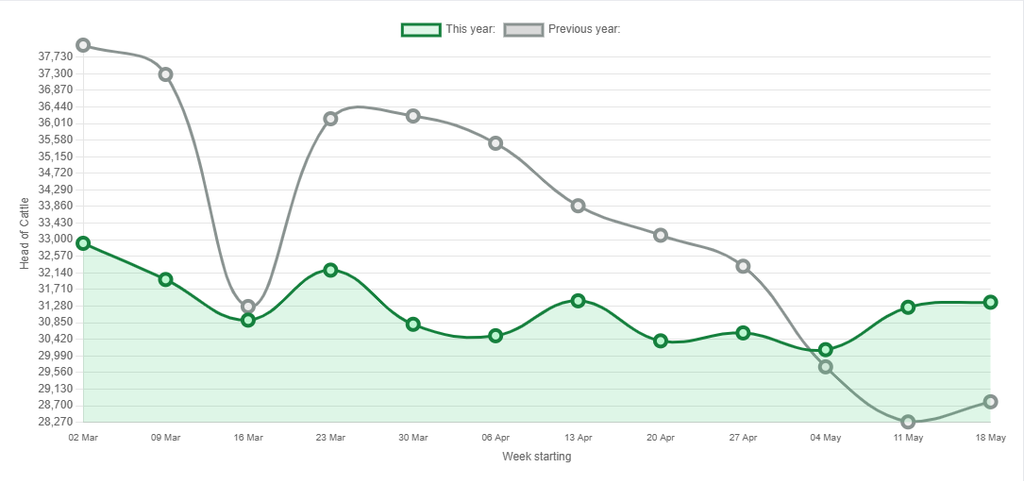
While weekly kill numbers have remained largely steady to date this year, supplies were high in the first half of 2025 and dropped off significantly into the second half of the year.
The notal number of cattle slaughtered to date this year stands at just over 645,000 head, down by 10.8% or just over 78,000 head on last year to date.
The cumulative deficit to date this year is expected to narrow as the year progresses, with weekly kill numbers for the second half of this year expected to be higher than corresponding weeks of 2025.