Winter crops well advanced at Kildalton Agricultural College


Crops of winter wheat, barley, oats and oilseed rape established at Kildalton Agricultural College last autumn are in "excellent" condition.
This was the overall perspective gained by farmers participating in a recent winter crops’ walk hosted by Teagasc at the Co. Kilkenny venue.
The event concluded a series of opportunities for tillage farmers in the south and south-east to meet up and walk winter crops while securing an update from Teagasc agronomists and crop scientists on the field work priorities that will come into focus over the coming weeks.
To facilitate the needs of tillage farmers in the north-east, Teagasc will host a winter crops’ walk on Thursday, February 19 at Derek Keeling’s farm Oldtown, Co. Dublin at 11:00a.m.
Winter oilseed rape
Speaking about the recent crop walk, Teagasc tillage specialist, Ciaran Collins commented: “The overwhelming viewpoint arrived at by the farmers taking part in the Kildalton event was the excellent standing of all the crops they had the opportunity of walking.
“Plant numbers were well above expected levels, with the winter oilseed rape looking particularly well.”
The opportunity was taken of gauging the Green Area Index (GAI) of the rape crops at Kildalton. The average figure came in at 2.8.
Collins said: “This crop would have one of the highest GAIs we have seen this spring, but there is a large range on farms so it is worthwhile getting into crops and taking a GAI measurement with the BASF app as this can result in significant savings on fertiliser for the farmer.

"In this scenario, a GAI of 2.8 equates to a fertiliser nitrogen saving of 125kg/ha compared to a crop with a GAI of less than 1.0.
"The key to canopy management in this crop is to delay the first split of nitrogen until mid-March, whereas a crop with a low GAI would need its first split of N as soon as growth commences," he added.
Plant growth regulation
Meanwhile, high plant numbers in winter cereal crops that are extremely forward at the present time bring two management priorities to the fore: fertiliser application planning; and the need to make best use of plant growth regulators.
Extremely high plant numbers can predispose crops to lodging, more so if the varieties established are inherently prone to going down in the first place.
The Teagasc tillage specialist commented: “When deciding on how best to prevent cereal crops from lodging, the first step is to review the specific commentary within the Department of Agriculture, Food and the Marine (DAFM) recommended lists for 2025/2026 where this matter is concerned.
“Varieties with poor resistance to lodging would need a split application of a plant growth regulator.
“Where wheat is concerned, regulator should be applied at Growth Stage 30 and Growth Stage 31/32.
“In the case of barley, regulator should be applied at Growth Stage 30 and then again at some stage between Growth Stages 32 and 37.”
Fertiliser
Where fertiliser application is concerned, there was a general consensus to the effect that such was not a priority with regard to the winter cereals growing at Kildalton.
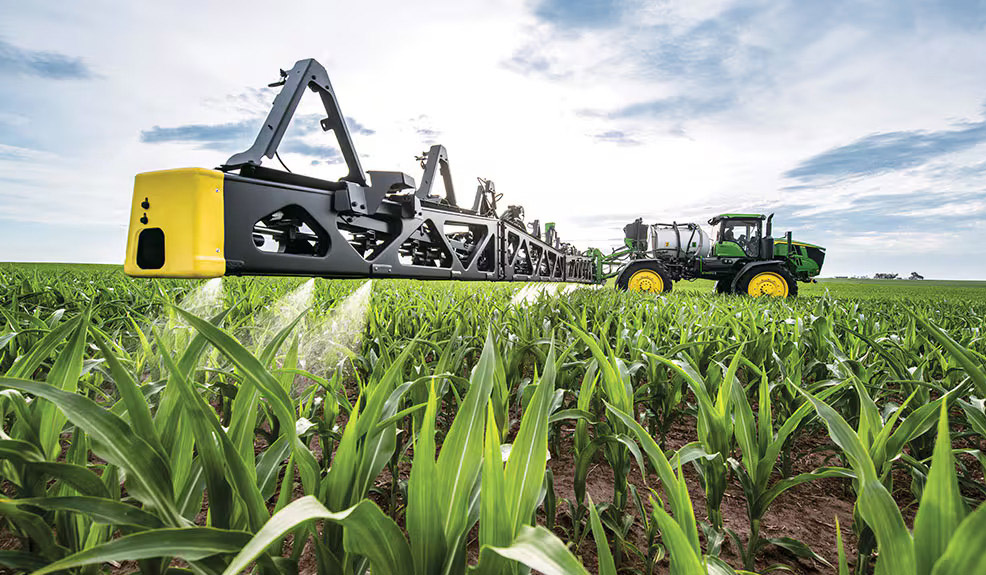
However, a debate is fast evolving on how best to apply crop nutrients to cereal crops: continuing with the use of a traditional fertiliser spinner or switching to liquid-based crop nutrients that can be applied with a sprayer. Products here include urea ammonium nitrate (UAN).
“UAN is a mix of urea, ammonium and nitrate," Collins explained.
"The great advantage of liquid N is the fact that they can be applied more precisely. And this is significant when it comes to making the best use of all crop inputs.
“A lot of tillage farmers now have access to GPS technology, making all of this possible.
“UAN is applied to the soil. And the fact that the nitrogen is already dissolved in water may result in a slight faster uptake of the crop nutrient.”
Yellow rust
Turning to disease control in winter crops, Teagasc is highlighting the very real threat posed by yellow rust in winter wheat crops in 2026.
This follows the breakdown of a specific yellow rust resistance gene in 2025. The issue was initially identified in the north-east of England.
However, Irish wheat crops were similarly impacted as last year’s growing season progressed.

Approximately 75% of the winter wheat varieties listed within the DAFM recommended lists for 2025/2026 will be susceptible to the yellow rust breakdown.
This works through to approximately 90% of the cropping area dedicated to winter wheat in Ireland last autumn.
“The varieties Champion and Graham are particularly susceptible to the challenge posed by the yellow rust breakdown.
“Tillage farmers in the north-east have been aware of the threat that can be posed by yellow rust for a number of years. However, this has not been the case in the rest of the country."
According to the tillage specialist, when it comes to dealing with yellow rust, the first step is to walk crops "as early in the season as possible".
“The disease manifests itself as groupings of yellow pustules, which will stand out very clearly against the green background of plant leaves," he said.
“Disease control is bset effected by the application of a T0 fungicide, or earlier if yellow rust is present, with a proven yellow rust chemistry.”
Tillage profitability
The recent National Tillage Conference highlighted the absolute importance of tillage farmers controlling costs and making optimal use of all the crop inputs applied in 2026.
Analysis of the data generated through the National Farm Survey over recent years has confirmed that profitability within tillage farming is dependent on three key factors: final yield secured; the efficiency of crop input applications; and the overall control of costs within a business.
Significantly, grain prices does not feature within these priorities.
This assertion was further endorsed courtesy of the figures detailed in the 2026 Crops Costs and Returns booklet.
“This approach is critically relevant when set against the backdrop of world grain prices projected to remain in the doldrums throughout 2026," Collins said.
“Tillage farmers will also be dealing with a scenario of rising fertiliser and machinery costs as 2026 progresses.
“This is why the focus of this year’s crop walks has been on the current priorities for winter cereal crops and oilseed rape.
“In the current climate, maximising the benefits of all inputs will be crucial for profitability.”
Turning to the prospects for spring crops in 2026, the Teagasc representative specifically highlighted the potential for beans.
“The crop has the potential to generate a positive margin in its own right," he said.
“But the availability of the Protein Aid payment provides a high degree of added certainty for growers.
“The figure for last year came in at around €600/ha. And we could be looking at the same again in 2026.”