Watch: A day in the life of a 420-cow dairy farmer


Before most people even hit their snooze button, the hum of the milking parlour echoes through the morning silence as the first milking of the day begins for dairy farmers.
Whether there is hail, rain, or snow, the cows must be tended to - but what does a day in the life of a farmer actually entail?
Agriland visited the farm of Mark Collins near Ballingarry, Co. Tipperary to see what a typical day can be like during spring calving.
Collins is milking 420 spring-calving Jersey crossbreds through a 60 bale rotary parlour, in what many would describe as a 'New Zealand-style system'.
The herd produced 530kg of milk solids in 2025, and is currently producing 21.5L of milk at 5.24% fat and 3.86% protein.
The farm operates under a low cost system, with a strong focus on grassland management, growing 14t/ha in 2025 on the 192ha platform, and utilising 12t of that at a stocking rate of 2.3 livestock units (LU)/ha.
The farm has also put a emphasis on breeding and herd health, with the herd's average Economic Breeding Index (EBI) sitting at €124 under the updated base value.

Collins, otherwise known as 'MC Milking It', returned to the farm in 2020 after completing Dairy Business in University College Dublin (UCD).
He is now farming alongside his parents, Padraig and Ena, as well as his partner, Mariana Gastaldi, with Supun Wickramarathne and Paul Urban also employed on the farm.
A day in the life
With a May 1 mating start date, Collins plans to begin calving on February 8, but admits it is usually February 1, meaning over 70% of the herd has already calved down here by the end of February.
That means it is all go on the farm from the crack of dawn, with the lights flickering on at 6:00a.m and cups on by 6:15a.m.
The parlour is usually finished up and washed out by 9:20a.m.

Currently colostrum cows are mobbed separately for five days post-calving, with Collins spending time stripping and California Mastitis Testing (CMT) each of them to ensure mastitis infections do not go amiss.
When fresh calvers are leaving the parlour, they receive their first and only dosing of the year for fluke and worms.
There is never a spare moment at the Collins family farm.
While milking is going on, someone will be out on the Daisy Bed, cleaning and liming the outdoor cubicles while the cows are in the parlour.
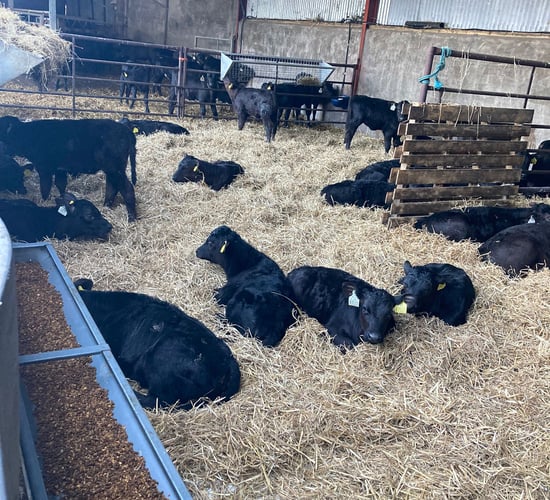
Meanwhile, another person will be feeding the calves whole milk at a rate of 7L/head in teat feeders, and someone else bottle feeds new-borns colostrum - which will have been tested using a colostrum refractometer during that milking.

When calves are born they are given 3L of beestings straight away, with Gastaldi saying they get more if they will drink it.
The Collins typically feed beestings with a quality of 25% or higher, keeping lower percentages in around the 20% mark for the second feeding.
There is a strick daily schedule to stick to because once the calves are fed, the parlour is washed out, and then cows are back on their clean, limed cubicles.
That means the team finally get a chance to take a short morning break, usually from 9:30a.m-10:00a.m.
Midday
Once the crew is back from their short breakfast break, it is full steam ahead as there are plenty more jobs to be done.
Considering the recent weather, the herd has only got four odd days at grass.
When they are housed, feeding takes up quite a bit of time in the afternoon.
Collins feeds the herd 73% dry matter digestibility (DMD) silage through a diet feeder alongside 2kg of barley, 1/2kg of soya, and 2kg of dairy nut in the parlour.
The feeder ensures his allocations are kept in order and allows him to stretch silage rations by adding straw during poor spring conditions.
He can mix minerals into the feed, minimising cases of milk fever and other metabolic issues.
While the herd is being fed, someone will ensure calves and calving pens have their bedding topped up, as well as cleaning out and liming dry cow cubicles.

Once the routine jobs are finished up, Collins' crew has an array of other tasks to be done, varying on the day.
For example, the local vet visits bi-weekly to sedate batches of calves that are between 10 days-of-age and two weeks-of-age for disbudding.
Collins said it is the one job he hates, but sedating them makes it much quicker and dramatically improves the animal welfare aspect.

As the weather improves, time may be saved on feeding silage, but the list of jobs dramatically increases.
The Tipperary farmer, along with every other farmer in the country, will be itching to get slurry and fertiliser out he gets a chance.
He theoretically has plenty of slurry storage, with a selection of slatted tanks alongside two slurry towers. However, as the farm is set up with open cubicles, they do collect quite a volume of rainwater in wet seasons like this year.
One other item on the schedule is that the farm will carry out grass walks and allocations once the weather improves.
But one upside for this system is that as beef calves are sold to private sellers, and replacement heifers go for contract rearing, there is the opportunity to free up some time.
Unfortunately this never lasts for long as the farm will not feel it until the breeding begins, where they use artificial insemination (AI) for the majority of the season.

Heifers are all bred to Angus, however the top percentile of cows will be inseminated with sexed semen.
In the evening, milking begins again at 3:00p.m, and Collins hopes to have his team finished up by 6:00p.m.
But, with farming, it is never plain sailing, as any issues that arise - such as a case of milk fever - mean Collins and Gastaldi may be on the farm further into the night.
And of course, at this time of the year, there is the added strain of nights for calving - but Padraig Collins takes the reigns on the shift.
It may be tough, but it is what you sign up for as a dairy farmer - and it is a life that is hard to beat.