Video: Inside 'dream' new Cavan suckler shed built to ease handling


Agriland recently visited an impressive new suckler shed in Co. Cavan that was built and designed with the ease of management of all tasks relating to a suckler herd in mind.
The newly build shed is a 'dream' setup by all accounts for a suckler farmer, and offers solutions to many of the often challenging management tasks associated with a good suckler herd.
Paddy and Sue Lynch are farming in Drumoghra, Co. Cavan, with the help of their son Paddy (junior).
Their enterprise is suckler farming and the farm is home to a herd of impressive commercial suckler cows, with a real focus evidently placed on functional suckler cows that have the capacity to calve and rear a good suckler-bred calf.
A new shed was recently completed on the farm with a range of interesting features included.
Before the new shed was built, the existing calving facilities on the farm included a basic dry-bedded shed for calving cows in.
Paddy (junior) said that the decision was taken to construct a new slatted shed and dry-bedded lieback with calving and handling facilities all under one roof.
"Mam and dad are still heavily involved in the running of the farm and we all know the dangers of working with livestock especially during the calving season so further improving the safety of our calving facilities was a priority," he said.

Paddy also works off farm so it is hoped the new shed can reduce the time needed to manage the herd and will help future proof the farm system.
"We wanted to build a new shed for calving the sucklers in just to make things easier and safer for us here at home."
The gallery below includes some of the key measurements and dimensions of the new shed:

The decision was made to build an open-fronted shed with a slatted area to the front, a dry-bedded area at the back with a creep gate for access and head-locking barriers in the creep area as well as a chute along the back wall of the shed.
The suckler shed has a total floor area of 221m2 or 2,378 square feet.

According to Paddy, the time from the initial decision was made to build the shed until it was completed took approximately two years.
"Between getting planning and Targeted Agriculture Modernisation Schemes (TAMS) approval, it took us about a year and another year then to actually build it," he said.
Before the plan for the shed was finalised, Paddy researched other suckler facilities and sheds and also went to agricultural shows to get an idea of what would best suit their needs.
Some of the features of the shed include:
- Clipex handling unit;
- Weighing scales;
- Leg hoist;
- Head-locking feed barriers in creep area;
- Calving gate;
- Gate system for filling and emptying cattle-handling chute.
- Double sliding door for access to clean out creep areas.
The shed has several points where cows can be restrained, including the calving gate; the head-locking barriers in the creep areas; and the Clipex cattle-handling unit at the end of the cattle chute.
The cost of the new facility
Paddy gave an approximate breakdown of the costings involved in the construction of the shed from start to finish.
The shed was eligible for TAMS support and Paddy's sister Patricia assisted with the TAMS application. All costs given are excluding VAT.
The table below details the approximate costings of the new suckler shed:
| Description | Cost excluding VAT | Summary |
|---|---|---|
| Commencement Fee | €1,000 | Planning and Drawings |
| Design and Draw | €1,050 | Planning and Drawings |
| Planning Application | €424 | Planning and Drawings |
| Digging - Site | €3,000 | Shed |
| Digging - Tank | €2,000 | Tank |
| Stone - Tank | €1,587 | Tank |
| Steel Rebars For Tank | €3,500 | Tank |
| Concrete - Tank | €9,956 | Tank |
| Contractor Labour Tank (Steel Tying, Concrete Pouring etc.) | €6,500 | Tank |
| Slats and Two External Agitation Points | €6,167 | Tank |
| Stone - Shed | €2,527 | Shed |
| Concrete - Shed (Foundations, Floors, Walls, Feed Passage etc.) | €13,293 | Shed |
| Shed Frame (Steel Structure, Sheeting, Doors etc.) | €25,300 | Shed |
| Steel Frame - Galvanise | €3,400 | Shed |
| Shed Kitout (Crush, Barriers, Drinkers etc.) | €18,500 | Shed |
| Contractor Labour - Shed (Pouring Concrete, Steel Erection, Kitout etc.) | €17,500 | Shed |
| Electric and Wiring | €1,500 | Shed |
| Camera | €1,100 | Shed |
| Other - (Pipes, Signs, Screws etc.) | €1,000 | Shed |
| Total Cost Excluding VAT | €119,304 | |
| Summary | ||
| Planning and Drawings | €2,474 | |
| Tank | €29,710 | |
| Shed | €87,120 | |
| Total Cost Excluding VAT | €119,304 | |
| Supports | ||
| TAMS 3 YFCIS - Shed | €53,541 | Young Farmers Capital Investment Scheme |
| TAMS 3 FSCIS - Crush | €4,003 | Farm Safety Capital Investment Scheme |
| TAMS 3 YFCIS - Tank | €19,766 | Young Farmers Capital Investment Scheme |
| Total Department Reference Cost | €77,310 | |
| 60% grant | €46,386 | |
| Cost after grant before Tax | €72,918 |
Paddy explained that the shed was built into a hill so digging costs were higher than usual.
The plans for the shed were drew up by Andrew O'Gorman from Cavan.
On the construction side, the labour was completed by Patrick Farrell from Coratubber, Co. Cavan.
The concrete and stone was sourced from Plunkett's Quarry in Finea, Co. Westmeath.
The slats were supplied by Wright Quarry Products and the steel works were completed by Sean Brady Engineering with some help on fabrication provided by Kevin McGovern.

The wiring of the shed was completed by Liam Langtry Electrical and Gerry Carroll installed a calving camera for the shed.
The gates, handling facilities and barriers were all sourced from Teemore Engineering.
New facility 'a lot safer'
Paddy said that they are delighted with how the project has turned out.
"The handling facility is a lot safer now and the features like the new head-locking barrier, head scoop, leg hoist, weighing scales allow for all these management tasks to be completed under one roof.

The handling unit can be operated from behind the animal and the sides opened if needs be.
The current suckler system on the farm
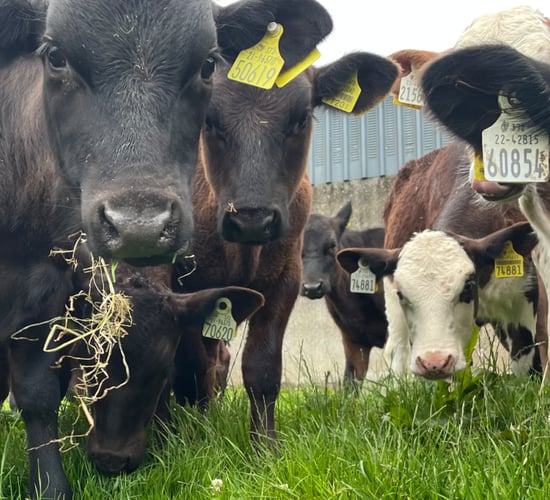
The cow type is predominantly large, strong, milky, fertile continental-bred cows.
Paddy explained that 100% artificial insemination (AI) is used on the herd and this has been the case for decades with no stock bull kept on the farm.

Some of the progeny are sold as weanlings and some are sold as store cattle with the best heifers retained for breeding.
Calving takes place in February and March and the breeding season gets underway in May.
"There's a mix of everything, mostly Limousin and Charolais but there's also Angus and a couple of Simmentals and Belgian Blues," he said.

Commenting on the choice of sire for the calves, he said: "In previous years, ZAG was the bull of choice on the farm but more recently, bulls like Powerful Proper and Lapon are also being used a lot.
"All the maiden heifers are served to an easy-calving Angus bull."
Paddy said that they currently have no plans to increase cow numbers but may consider doing so in the future.
Commenting on his plans for the future, he said he hopes to "try tighten up the calving pattern" this year and is also considering getting collars for the cows to help detect those in heat.

"I've talked to some suckler farmers using them [heat detection collars] and they are very happy with them.
"We might have to move a few drinkers in paddocks closer to the yard so the signals will ping back."
He added that the collars would allow for some flexibility during breeding season, saying: "90% of the time you are checking the cows for heats, but if you are away for the day it should help pick up cows in heat that could otherwise be missed."
New shed functionality
The farm already has ample slurry storage so no tank was installed under the creep area.
The new facility on the farm will reduce pressure on space for calved cows in the event of a late spring.

Commenting on some of the features of the new shed, Paddy said the head-lock barriers in the creep area are "a great bonus".
"We can close a fresh-calved cow in the creep pen and can also feed cows separately from the back if we are fattening cows not in-calf for example."
The open-front at the slatted area feed space leaves the shed "bright and airy but not too draughty."
The new suckler shed is a good example of modernising a typical Irish suckler system ensuring cattle can be handled in a safer environment and the herd managed in a more simplified manner.