Advantage Beef Programme
The list has been made available ahead of the 2026 breeding season for spring-calving dairy herds.
Speaking to Agriland, David O'Connell from the Advantage Beef Programme team explained that the list includes a range of beef bulls suitable for use on the dairy herd.
"The list includes suitable beef breed bulls for dairy farmers to use on heifers, second calvers, cows, and mature cows.
"These sires have been picked to suit the dairy farmer who will be calving the cows as well as the beef farmers who will be purchasing the calves to rear these animals for beef production," he said.
The table below includes the details of the Advantage Beef Programme's recommended bull list for the 2026 breeding season:
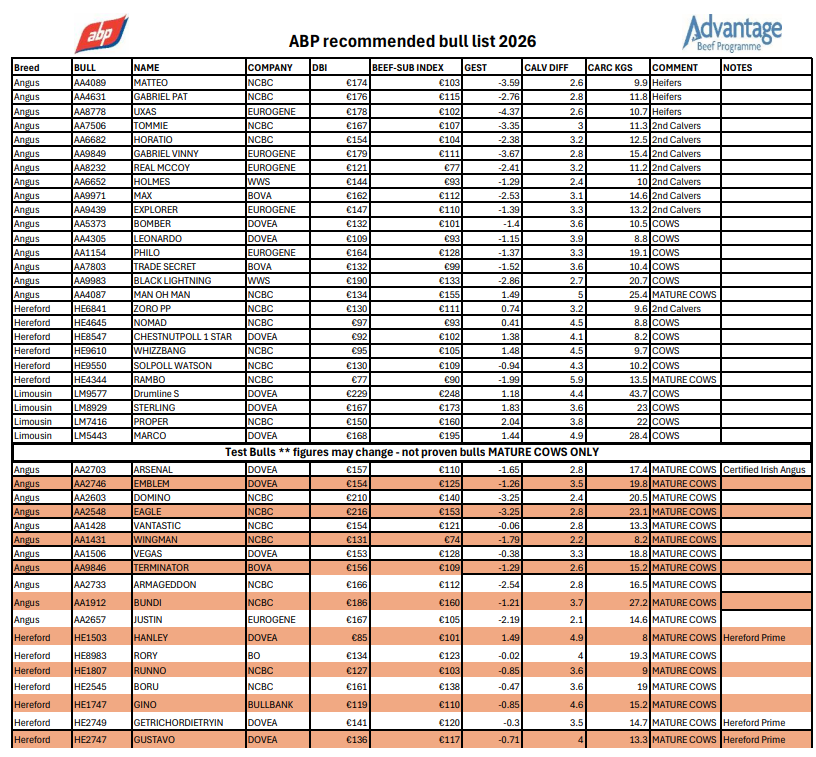
David said: "The bulls included on the list are easy calving and short gestation. These traits are of interest to the dairy farmer.
"The bulls on this list also possess good genetic potential to deliver progeny with improved carcass weight and confirmation traits. These traits will be of interest to the beef farmer purchasing the calf for rearing.
"The bulls featured at the bottom of the list are test bulls and are recommended only for use on mature cows."
The sires featured on the list above are available through the following artificial insemination (AI) companies:
- National Cattle Breeding Centre (NCBC);
- Dovea Genetics;
- Eurogene;
- World Wide Sires (WWS);
- BOVA AI;
- Bó Sires;
- Bullbank.
David said that the Advantage Beef Programme farm liaison team "is happy to assist farmers in selecting the most suitable beef genetics to maximise calf quality across all AI providers".
He also encouraged both dairy and suckler farmers breeding cows this year to contact the team for sire selection advice.
ABP Demo Farm
The ABP Demo Farm in Co. Carlow has been undertaking research on beef calves coming from the dairy herd for over a decade now.
There are over 400 calves bought each year, meaning there has been over 5,500 progeny tested on farm bred from 400 different sires.
O'Connell said that the farm places a major emphasis on comparing the performance of the progeny bred from a range of sires to each other and assessing performance under the same conditions, from arrival on farm as a calf all the way to slaughter.
"The purpose of this research is to demonstrate to farmers that by looking at better beef genetics when purchasing calves, they can increase profitability without doing anything different."
Trials completed on the ABP Demo Farm have shown that there is a carcass advantage of +38kg (or €266 in value) between the top 25% of CBV and the bottom 25%.
These higher CBV animals are proven to kill out at better carcass weights and better carcass conformation at a younger age.
Spring 2026
This year, the yearlings on the ABP Demo Farm are averaging 323kg at turnout.
The heaviest yearling on the farm this year is a 485kg Angus bullock.
He is sired by Westellen Boss (AA9860) who has a Dairy Beef Index (DBI) of €142.
David said: "By using sires like this with high beef indexes, farmers can greatly improve carcass weights, conformation and age at finish while reducing their farm’s carbon footprint".
Tips for selecting suitable beef sires for dairy cows
He explained that farmers who are producing beef calves from the dairy herd for the calf-to-beef market should first select the level of calving difficulty they are comfortable with based on the cow.
This level of calving difficulty will generally vary for heifers, second calvers, cows and mature cows.
Once the calving difficulty level has been identified, farmers should then look to use bulls that have:
- High carcass weight;
- High carcass conformation;
- Lower age of finish.
Bulls with a higher DBI will already have these taken into account, but it is important to still look at the individual beef sub-indexes when selecting a sire based off DBI.
"By selecting these better beef merit bulls, the dairy farmer can produce a quality calf which will perform well for the purchaser, while still not compromising on calving difficulty or gestation."