Reminder: Zone A farmers can now spread slurry

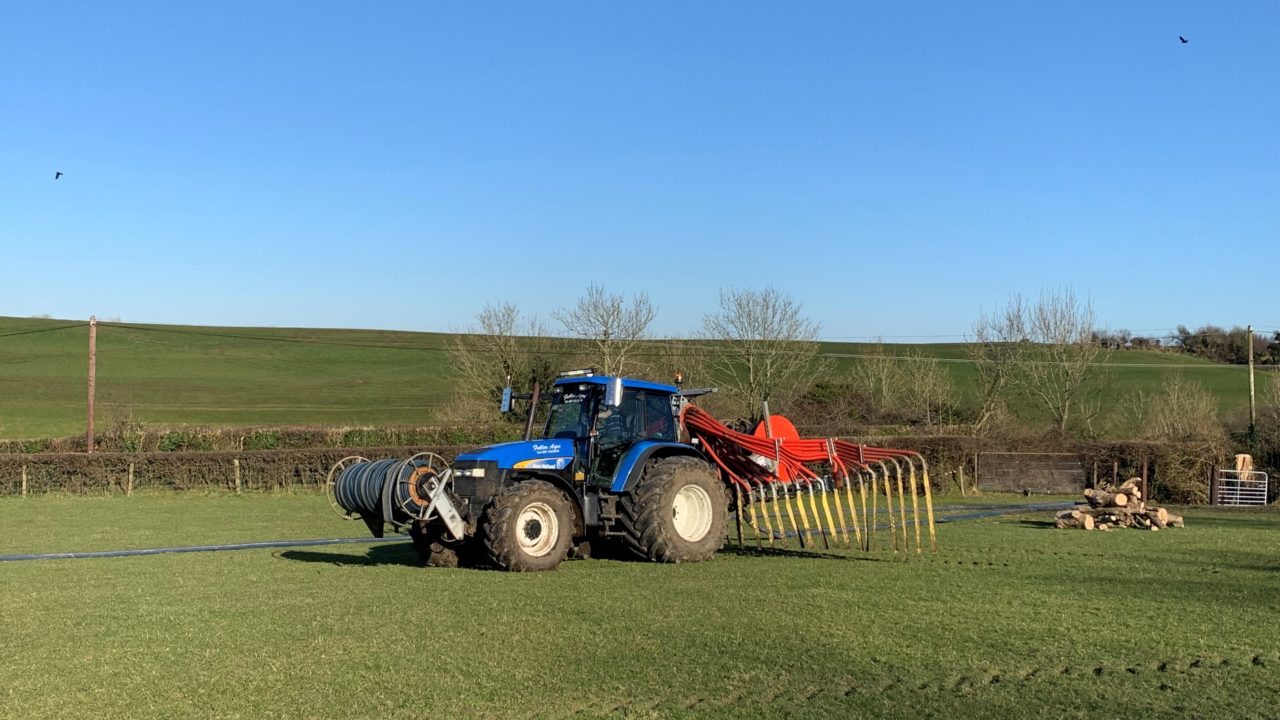
The restricted period for organic and farmyard manure, which includes slurry, has reopened for farmers in Zone A.
Farmers in this zone, as well as zones not yet open, now need to put a plan in motion to get the timing and spreading of their slurry right this spring.
Slurry is a very valuable source of nutrients on the farm and can be a huge addition to grass growth in early spring if applied correctly and while in good condition.
Slurry can be estimated to be worth around €30-€35 per 1,000/gal if you take into account the nitrogen (N), potassium (K), and phosphorus (P) in it, according to Teagasc.
This means applying 1,000gal of slurry at 6% dry matter (DM) to grass is equivalent to a 50kg bag of 9-5-32 fertiliser when applied correctly.
Therefore, knowing the value of the slurry in your yard and planning how to spread it properly is essential is boosting margins on the farm.

The last day of the restricted period for Zone B farmers is Thursday, January 15, while Zone C finishes up on Saturday, January 31.
Timing of slurry
Firstly farmers should consider testing their slurry to understand what nutrients they have available.
Once the results are back, farmers can begin targeting paddocks which need it most, remembering that farms stocked at or above 100kg N/ha are obligated to use low emission slurry spreading (LESS).
The timing of slurry application has a large influence on the uptake of nutrients by the plants, which determines the success of using your slurry effectively.
Ideally, slurry should not be spread in conditions where you would not spread chemical nitrogen; for example, waiting until soil temperatures are 6℃ and above, as it means that grass is growing and has the potential to take up nutrients.

However, despite it being easy to talk about when the best time to get out slurry is, the reality is that farmers will have to spread as soon as the spreading period opens up, due to storage availability.
If this is the case on your farm, consider examining your slurry storage for next year for problems such as clean rain water entering the tanks and impacting storage space.
If slurry does have to be spread straight away, spread well away from rivers, streams, and flow channels, and try to target drier paddocks on the farm.
Farmers also need to consider the soil moisture content of the land, as if the soil is saturated, going out with a tanker will cause structural damage and will lead to surface water runoff.
Targeting paddocks
Choosing which paddocks to apply the first of the slurry to is an important step and should be based on soil test results.
Farmers need to be targeting paddocks that are low on phosphorus (P) and potassium (K).
When applying slurry early, it is advisable to match the rates of application of slurry to the growth rates of the grass, remembering how low growth rates are this early in the year.
When 2,000 gals/ac is applied using LESS, it will supply around 20 kg/ha (16 units/ac) of available nitrogen (N)
When 2,500 gals/ac is applied, it will supply around 25kg/ha (20 units/ac) of available N.
Slurry applications need to be managed to ensure that no more than 2,500 gal/ac applied in each application in the early spring.