Planning for lime applications in 2026

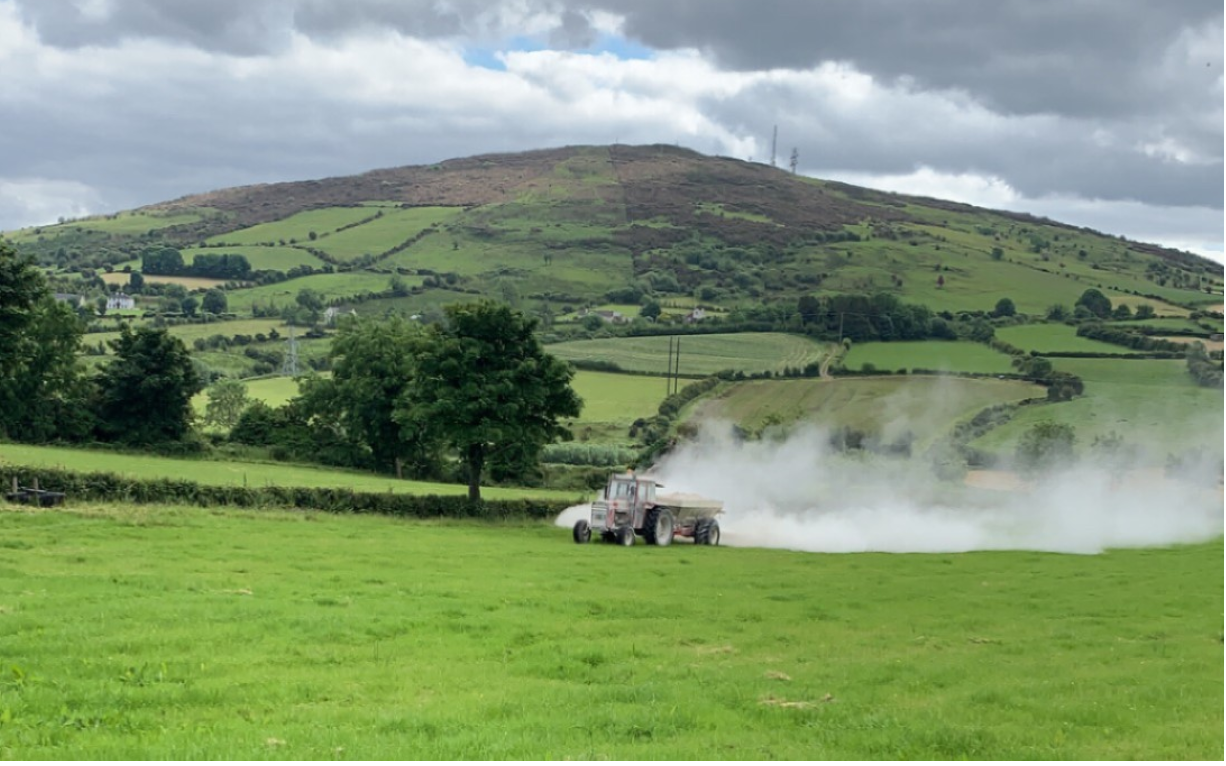
Lime will not be getting out on any paddocks at the minute given the rain, however farmers should be planning for its use during the year.
Lime can be used as a low cost fertiliser on farms across the country, yet more than half of Irish land tests sub-optimal for pH levels and major nutrients.
It's all well throwing out as much nitrogen as you are allowed, but with protected urea costing more than €600/t, farmers should be making the most of lime.
And getting the full efficiency out of your nitrogen (N) starts with correcting the farm's soil pH.
Spreading lime has one of the quickest returns on investment across any measure taken on farms.
Every €1 invested can return up to €7 in the form of extra grass growth, reduced N usage and increased soil fertility.
Liming acidic soils increases grass production by 1.0t dry matter (DM)/ha as the supply of N to soil is increased by up to 70kgN/ha/year, meaning savings of €40/ac in controlled N use can be achieved, according to Teagasc.
Liming paddocks has also become far more important in terms of getting maximum efficiency out of your phosphorus (P) allowance.
The affect of lime on N and P is as following, according to Teagasc:

Lime application
Lime was often seen as a back-end job in October, November and December, but with increasingly unpredictable weather patterns, more farmers are opting to get lime out during spring reseeds.
Obviously, with the way weather conditions are currently, thoughts of lime are well out of mind.
But in reality, farmers should be analysing nutrient levels of their farms so they can begin to plan lime applications in the spring and place their orders.
In order to keep your soil fertility at an optimum, you should be collecting samples every two years to keep up to date and ahead of your soil fertility rather than every four years.
Target paddocks that have just been grazed out or those put forward for reseeding.
Avoid spreading lime on high covers of over 800kg DM/ha, otherwise there will more than likely be lime residues on the grass when cows get back around to graze it.
Farmers should be hitting these low covers with rates of roughly 2.5t/ac depending on the requirements, remembering that paddocks in a serious deficit can not receive more than 5t/ac within two years.
Silage, slurry, and urea
Sufficient time should be left of up to three months in dry weather between applying lime and closing for grass silage to make sure the lime is fully washed into the soil.
Residues in grass silage may affect good preservation conditions when the grass is ensiled in a silage pit or a bale.
When cattle slurry is spread too soon after lime was applied and the lime is not fully absorbed by the soil, it can result in a loss of up to 50% of the available N.
In order to prevent this from happening and to minimise N losses, apply slurry first and then lime a week to 10 days later, once covers are still low.
N loss through ammonia N volatisation occurs where straight urea is applied on recently limed land. It should be applied a week to seven days prior to lime spreading unless protected urea is used.
High molybdenum soils can cause a copper deficiency in grazing animals.
On these soils, when soil pH goes above 6.2, the availability of molybdenum increases and so a soil pH of 6.1-6.2 should be maintained unless the cows are supplemented with copper.