Dairygold CEO: Milk supply in 2026 has continued to increase

Dairygold's milk supply grew in 2025, with 1.44 billion litres of milk processed, the co-op said.
According to the co-op's chief executive officer, supply has continued to increase so far this year.
Dairygold has today (Wednesday, April 8) published its financial results for 2025.
Despite what it described as a challenging year marked by exceptional market volatility, Dairygold delivered a "resilient" financial performance, recording a turnover of €1.5 billion, earnings (EBITDA) of €52.7 million and an operating profit of €21.3 million, for the year.
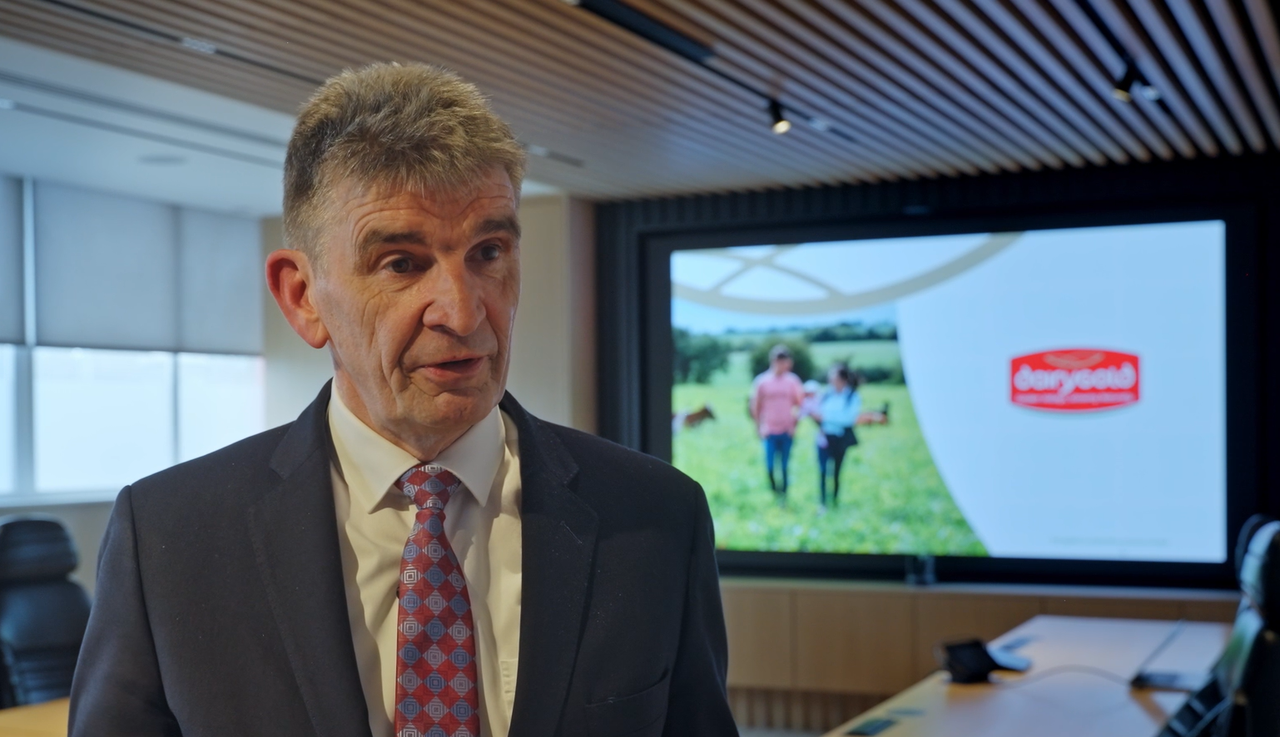
Speaking to Agriland, Dairygold chief executive, Michael Harte said that in 2025, milk supply reached 1.44 billion litres, an increase of 58 million litres or over 4% on 2024.
“We've also seen milk solids continue to increase. Our milk solids in 2025 were 8.07%, an increase of 0.08% on 2024,” Harte said.
“That meant that the average cow produced 454kg of milk solids in Dairygold in 2025, which was a record".
In 2010, average milk solids were 7.29%, Harte said.
"They increased to 8.07% in 2025, an increase of nearly 11% overall," he added.
"That's a testament to the practices that are being adopted by our milk suppliers, the genetics they're using, which is really positive and really important for us as an organisation.”
Outlook
Harte noted that milk supply in 2026 has continued to increase.
“We’ve seen milk supply in the first three months increase by 4% again on 2025 volumes.
“That reflects increased cow numbers, early calving, and also healthier cows are the factors that are contributing to this.
“At the end of the day, the outlook for milk supply in 2026 will probably be determined predominantly by weather.
“In 2025, weather was very, very favourable, which helped milk production, so we'll have to wait and see how 2026 will outturn in relation to weather.”
Global milk
Harte highlighted that, unfortunately, global milk supply has increased significantly, which is really impacting dairy market returns.
“Global milk supply in 2025 was up 2.5%, but global milk supply in the last quarter was up between 4% to 5%, a real challenge.
“That increased volume onto the market, meant that product prices declined significantly, and what happened was that buyers stood back from the market, and left prices fall, and that was a significant challenge.
“We saw milk prices declined back into the mid-30s at the end of 2025.”
Harte said it is “very, very difficult to predict” where milk price will be in 2026.
“We have the challenge with regards to global milk supply, expectations are that global mix supply will fall off especially by H2, that milk volumes will reduce,” the Dairygold chief executive continued.
“But the early months are not giving us any indication that is going to happen.”
Improved demand
However, Harte said that demand has improved. Lower prices have helped to stimulate the market for dairy products.
“The long-term trends for dairy ingredients is positive," he continued.
“From a nutrition and from a health perspective, dairy ingredients are sought after by people, so there is positivity in relation to that.
“We have seen improvement in relation to skim milk powder, protein products overall.
“But butter prices originally started to increase, but now have fallen again, in the first quarter of 2026.”
He added that the situation in the Middle East is also a big challenge for industry at the moment, with volatility remaining a key feature.