Beans highlighted as a positive spring cropping option for 2026


Teagasc is confirming that beans represent an extremely attractive spring cropping option for tillage farmers in 2026.
There are a number of reasons for this, chief amongst them being the envisaged €600/ha Protein Aid payment and the fact that forward prices are currently sitting at €230/t.
The Protein Aid figure is based on a projected planting area of 13,000ha.
Beans are more profitable than spring feed barley but also increase profitability across the rotation, according to Teagasc.
Guideline variable production costs against the crops will come in at around €1,100.
Planting
Growers should plant beans as soon as conditions are suitable. The target is to have beans sown by mid-March.
In addition to a late harvest, the yield potential of beans is reduced when sown after mid-March. However, it is important not compromise on seedbed conditions.
Aiming for a target plant population of 25-30 plants per square metre is optimal. Plant population numbers should be increased to 40 per square metre for later sowing or on unproductive soils.
A thousand grain weight (TGW) of 550g will need a sowing rate of 206 kg/ha (13.1 st/ac). Growers should take note of the TGW on the bag as big seed requires high seed rates.
It is essential that pre-emergence residual herbicides are used on beans.
According to Teagasc, the main options are: Nirvana 4.0-4.5L/ha; Nirvana 2.5 + Defy 4.0L/ha; Stallion 3.0L/ha; and Chanon/Emerger 2.5 + Defy 2.5L/ha.
Like all crops, beans need the best possible start.
Soil types
Beans can be grown in a wide range of soil types but generally the ideal soil type is a medium to heavy clay loam.
Yields of beans, on light soils in dry seasons will be disappointing if drought occurs.
Beans should not be grown on peat or soils with a high organic matter content, as mineral deficiencies can occur.
Medium soils allow good root development and will usually retain enough moisture to meet the needs of the crop. Also, medium type soils will dry out reasonably quickly in the springtime, and allow sowing to proceed in good time.
Compacted soils should be avoided, or soils where draining is impeded.
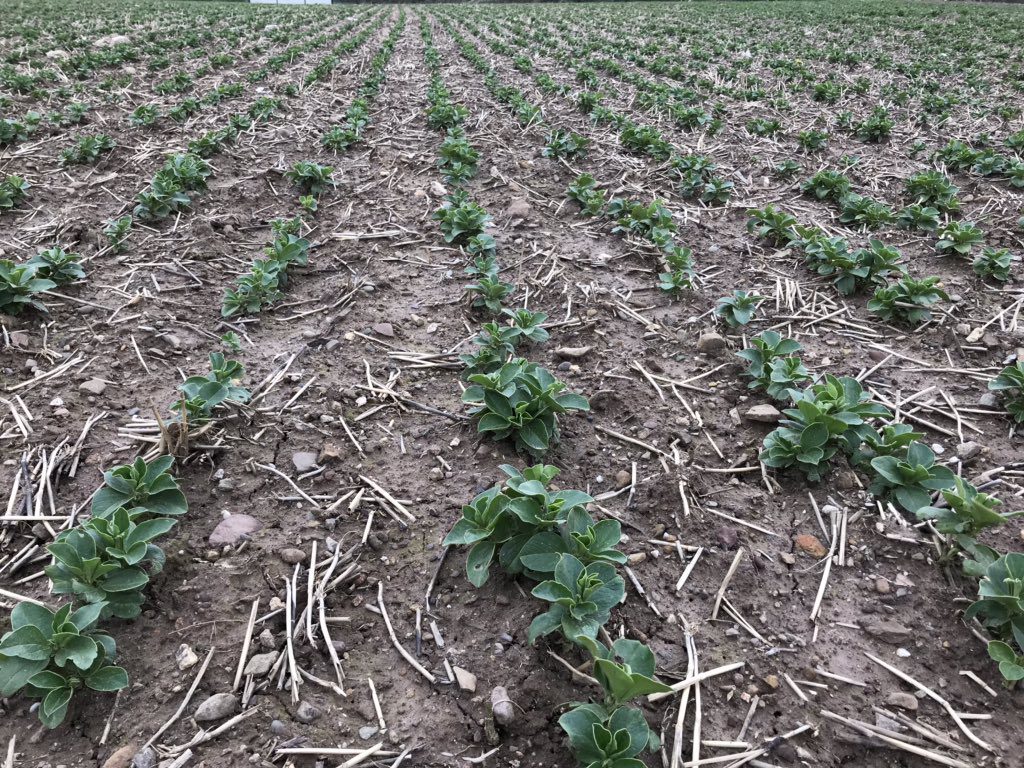
If water logging occurs, root development will be stunted, and complete crop failure can result.
Water logging will also stunt root growth and reduce nitrogen fixation. It will also increase crop susceptibility to frost damage and disease, all of which reduces yields.
The optimum soil pH for beans is in the range 6.5-7.0.
If the pH reading drops below 6.0 then an application of lime is needed.
As beans are susceptible to a wide range of soil-borne pests and diseases, a strict rotation is necessary.
A five-year break is essential between bean crops.
It is desirable that oilseed rape should not have been grown during the previous two years because of the risk of sclerotinia disease.